
When a parent types ‘pediatrician near me’ at 9 p.m. on a Tuesday, they aren’t browsing. They’re choosing. Within 30 seconds, they will tap a phone number, get directions, or close the tab and try the next clinic. The whole healthcare local search market now lives in that half-minute window.
And the window is getting smaller. Google’s local pack, AI Overviews, voice assistants, and ChatGPT-style answer engines are all pulling the same patient toward a single ‘best answer’ — usually one provider, sometimes three, almost never ten. If your practice isn’t the answer, you don’t get a second look.
This guide is the playbook Medcore Digital uses to put healthcare providers inside that answer. It covers what’s changed in 2026 — entity optimization, GEO SEO, the new Google Business Profile, structured data, voice search, and the local pack — and gives you a clear path to dominate near me healthcare searches in your service area.
Why ‘Near Me’ Healthcare Searches Decide Who Gets the Patient
Local intent has always mattered for healthcare. What’s new is how dominant it has become — and how much of it now happens without a click.
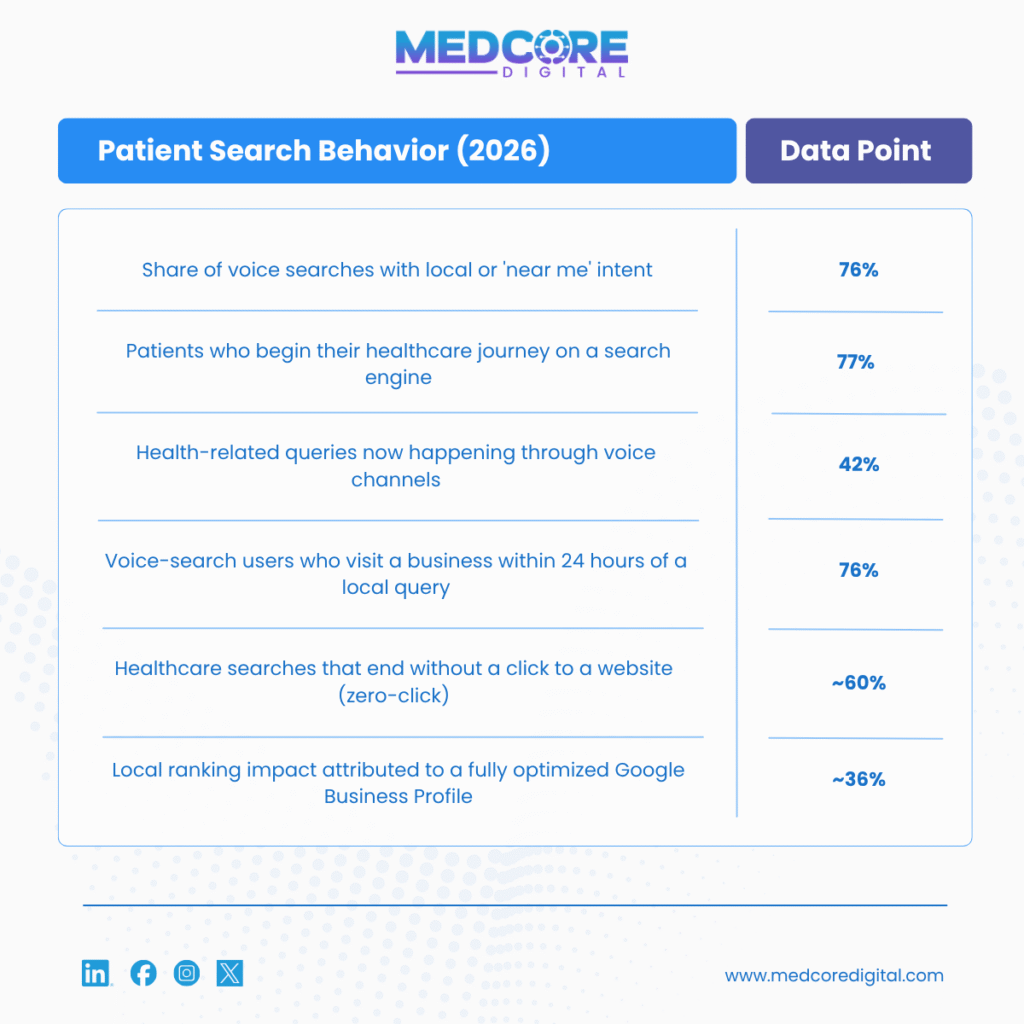
Sources: BrightLocal, Statista, DemandSage, Google health initiative reports, Roketto Healthcare SEO 2026.
Three forces are reshaping patient proximity search this year:
- AI Overviews are answering symptom and ‘find a provider’ questions above the organic results, often citing only two or three sources.
- Voice assistants are returning a single spoken answer for queries like ‘who’s the best dentist near me open Saturday’.
- The local pack (the three map results) now drives the majority of high-intent patient acquisition for clinics, urgent care, and specialty practices.
Practices that show up in all three are full. Practices that show up in none are invisible — even if they’re literally across the street from the patient.
The 2026 Search Landscape: Local Pack, AI Overviews, Voice, and the LLMs
A ‘near me’ query in 2026 doesn’t mean one thing. It triggers a stack of surfaces, each with its own ranking logic. Healthcare providers who treat them as a single funnel — instead of one search box — start winning.
1. The Local Pack (Map 3-Pack)
The three pinned results on Google Maps still drive most local patient acquisition. Ranking is decided by relevance (does your Google Business Profile match the query?), distance (proximity to the searcher), and prominence (reviews, citations, branded search volume, link authority).
2. AI Overviews
Google now generates a synthesized answer for a meaningful chunk of medical queries — symptoms, treatments, ‘best provider’ questions. Inclusion is driven by E-E-A-T signals, structured data (FAQPage, MedicalWebPage, MedicalOrganization), clear Q&A formatting, and authority of the source domain. Get cited here and you earn visibility without a click; get excluded and you slide down the page.
3. Voice Search
Roughly three out of four voice queries carry local or ‘near me’ intent. Voice answers are pulled almost entirely from featured snippets, Google Business Profiles, and structured Q&A content. There is no second result. Voice is winner-take-all.
4. LLMs and Answer Engines (ChatGPT, Perplexity, Gemini, Claude)
Patients increasingly start with an LLM: ‘Find me a five-star rated orthopedic surgeon in Dallas who takes Aetna.’ These tools cite Reddit threads, Google Business Profiles, healthcare directories, and structured medical content. According to BrightLocal’s 2024 Consumer Review Survey, 78% of consumers now discover local businesses through AI-generated recommendations. That number is climbing.
| What this means for your practice: You are no longer optimizing one website for one search engine. You are optimizing one verifiable medical entity across Google Search, Google Maps, Apple Maps, Bing, ChatGPT, Perplexity, Gemini, Siri, and dozens of healthcare directories. Consistency is the new ranking signal. |
Google Business Profile: The New Homepage for Healthcare
In 2026, your Google Business Profile (GBP) is doing more work than your website. Patients scan the local pack, read reviews, check photos, look at hours, and book — often without ever visiting your site. A complete, well-optimized GBP makes a medical practice roughly 70% more likely to attract patient visits.
Here’s what ‘optimized’ actually means now.
Lock Down Your NAP and Categories
- Name, Address, Phone (NAP): Identical, character-for-character, across your website, GBP, and every directory. Any deviation triggers Google’s spam filters.
- Primary category: Use the most precise option available — ‘Pediatric Dentist’ instead of ‘Dentist’, ‘Orthopedic Surgeon’ instead of ‘Doctor’.
- Secondary categories: Add the conditions you actually treat. A dermatology practice should add categories for skin cancer screening, cosmetic dermatologist, and laser hair removal clinic, where applicable.
- Local phone number: Use a number with a local area code as the primary. Toll-free national numbers across multiple locations dilute your local relevance.
Treat the Profile Like a Living Asset
Static profiles disappear from AI-driven search. The practices winning the local pack in 2026 publish on their GBP the way you’d post on social media.
- Google Posts: 1–2 per week covering new services, new providers, seasonal health topics, and clinic events.
- Photos: real, geotagged, well-lit images of the office, staff, and equipment. Listings with quality photos receive up to 42% more direction requests and calls.
- Q&A section: pre-populate the most common patient questions yourself. Include insurance accepted, parking, telehealth options, and walk-in policy.
- Services menu: list every service with its own keyword-rich description (e.g., ‘Same-day strep throat testing’, ‘IUD placement and removal’).
- Review responses: respond to every review within 24 hours. Google now moderates responses and uses response rate as a ranking signal.
Reserve with Google and Booking Integration
If a competitor lets a patient book in two taps and you require a phone call, you’ll lose the lead — full stop. Connect your scheduling system (Zocdoc, NexHealth, Phreesia, or your EHR’s API) so patients can see real-time availability and book directly inside Google. Every step you remove between query and confirmed appointment shows up in your booking volume.
Reviews: Volume, Velocity, and Recency
Practices with 50+ reviews and a rating above 4.5 see a measurable advantage in local pack rankings. But raw count isn’t enough anymore. Google’s local algorithm now weighs:
- Velocity (steady flow of new reviews vs. one big batch)
- Recency (reviews from the last 60–90 days carry more weight)
- Keyword content within reviews (a review that mentions ‘Botox’ or ‘pediatric ADHD evaluation’ helps you rank for those terms)
- Response rate and quality
- Reviews on platforms beyond Google: Healthgrades, Zocdoc, Vitals, and Yelp all feed your prominence score
Entity Optimization: How LLMs Actually ‘See’ Your Practice
Search engines and LLMs don’t index your website the way they used to. They build an entity graph — a structured understanding of what you are, what you do, where you are, and who vouches for you. When a patient asks ChatGPT ‘who’s the best cardiologist in Plano,’ the model checks its understanding of your entity against thousands of others and decides whether to mention you.
Cross-platform entity verification is now estimated to drive over 70% of local ranking signals. That means LLMs and search engines compare your information across Reddit, Quora, healthcare directories, social profiles, your website, your GBP, and news mentions. Inconsistencies don’t just hurt — they trigger silent suppression.
Build a Single, Verifiable Entity
- Identical NAP: Google Business Profile, Apple Maps, Bing Places, Healthgrades, Zocdoc, Vitals, Yelp, your website footer, schema markup. All exact.
- Primary directory presence: Active, claimed profiles on at least 3 industry-specific directories (Healthgrades, Zocdoc, Vitals, Doximity for physicians).
- Verified social accounts: Same name, same logo, same description across LinkedIn, Facebook, Instagram, and TikTok where relevant.
- Third-party mentions: Local news features, podcast guest spots, professional association listings, and community sponsorships. LLMs use these to confirm you exist.
- Knowledge graph signals: Wikidata entry, association directory listings, and Wikipedia mentions where eligible. These anchor your entity to known authorities.
This is what ‘GEO SEO’ (Generative Engine Optimization) actually looks like in practice — building a verifiable, distributed digital fingerprint that AI engines can confirm from multiple angles.
Structured Data: The Schema Healthcare Sites Can’t Skip
Schema markup is structured data that tells search engines and AI engines exactly what your content means, not just what it says. For healthcare, it’s the difference between a search engine ‘guessing’ you’re a clinic and confirming you’re a board-certified dermatology practice that treats psoriasis and accepts Blue Cross.
A Nestlé R&D study reported that pages with rich-result schema saw an 82% higher click-through rate than pages without. For YMYL (Your Money or Your Life) content like healthcare, the lift is even more pronounced because trust signals matter so much.
The Six Schema Types Every Healthcare Site Needs
- MedicalOrganization (or MedicalClinic / Hospital / PhysiciansOffice): Top-level entity for your practice. Includes name, address, phone, hours, geo coordinates, medical specialty, and accepted insurance.
- Physician (or IndividualPhysician): One per provider. Include credential, medicalSpecialty, hospitalAffiliation, memberOf (links them back to your MedicalOrganization), and aggregateRating.
- MedicalSpecialty: Used inside Physician and MedicalOrganization to define what you treat.
- MedicalProcedure / MedicalTherapy: One per service page. Patients searching for specific procedures (e.g., ‘knee arthroscopy’) need this connection.
- MedicalCondition: Used on condition pages (e.g., ‘Type 2 Diabetes Treatment’) to anchor symptoms, causes, and treatments.
- FAQPage: Healthcare retains exclusive access to FAQ rich results in Google search. Use it on every service and location page.
Sample Medical Clinic Schema (Drop In)
<script type=”application/ld+json”> { “@context”: “https://schema.org”, “@type”: “MedicalClinic”, “name”: “Lakewood Family Health”, “image”: “https://example.com/clinic.jpg”, “url”: “https://example.com”, “telephone”: “+1-214-555-0118”, “address”: { “@type”: “PostalAddress”, “streetAddress”: “1245 Abrams Rd”, “addressLocality”: “Dallas”, “addressRegion”: “TX”, “postalCode”: “75214”, “addressCountry”: “US” }, “geo”: { “@type”: “GeoCoordinates”, “latitude”: 32.821, “longitude”: -96.741 }, “openingHoursSpecification”: [{ “@type”: “OpeningHoursSpecification”, “dayOfWeek”: [“Monday”,”Tuesday”,”Wednesday”,”Thursday”,”Friday”], “opens”: “08:00”, “closes”: “18:00” }], “medicalSpecialty”: [“FamilyMedicine”,”Pediatric”], “availableService”: [{ “@type”: “MedicalProcedure”, “name”: “Annual Wellness Exam” }], “aggregateRating”: { “@type”: “AggregateRating”, “ratingValue”: “4.9”, “reviewCount”: “287” } } </script> |
Validate every implementation with Google’s Rich Results Test and the Schema.org Validator. Then monitor Search Console’s Enhancements report so you catch warnings before they become ranking losses.
Local Content Strategy: Building Pages Patients (and AI) Trust
If you serve more than one neighborhood or city, generic ‘service area’ pages won’t cut it anymore. AI engines need geographic specificity to confidently recommend you for a ‘near me’ query. Patients need it to feel like you actually understand their area.
One Page Per Location, One Page Per Service Per Location
A single dermatology practice with two offices in Dallas and Plano needs at minimum:
- A homepage describing the practice as a whole
- Two location pages — Dallas and Plano — each with full NAP, embedded map, location-specific reviews, and unique provider photos
- Service pages (acne treatment, Botox, skin cancer screening, etc.) — one for each service
- Service-by-location pages where intent justifies it (‘Botox in Plano’)
Each page should reference the actual neighborhood, nearby landmarks, parking notes, public transit options, and the patient population you typically see there. This isn’t keyword stuffing — it’s the kind of detail that proves to both Google and an LLM that you genuinely operate in that ZIP code.
Use Geo-Modified Keywords Naturally
Across page titles, H1s, meta descriptions, image alt text, and body copy, weave in:
- City names (‘dermatologist in Plano’)
- Neighborhood and district identifiers (‘West Plano’, ‘Legacy West’)
- Local landmarks (‘near The Shops at Legacy’)
- Regional health concerns where relevant (‘seasonal allergy testing for North Texas pollen’)
Answer the Questions Patients Actually Ask
AI Overviews and voice assistants overwhelmingly pull from question-and-answer formatted content. About 70% of voice queries are phrased as full questions, compared to 12% of typed searches. Build content that mirrors how patients speak:
- ‘How much does an MRI cost without insurance in [city]?’
- ‘Is the [your clinic] urgent care open on Sundays?’
- ‘What insurance does [practice name] accept?’
- ‘How long is the wait at [practice] for a same-day appointment?’
Each answer should be 40–60 words, direct, and structured for snippet eligibility. Stack these on FAQ pages and at the bottom of service and location pages, then mark them up with FAQPage schema.
Voice Search for Clinics: Winning the Spoken Answer
About 19 million Americans have already used a voice assistant for healthcare questions, and roughly two-thirds of those queries are local. By the end of 2026, the U.S. will have an estimated 157 million voice assistant users. There is no second place in voice — the assistant reads one answer, and that’s the practice the patient calls.
How Voice Differs from Typed Search
- Longer, conversational queries (‘Where’s the closest urgent care that’s open right now?’)
- Higher local intent — 76% of all voice queries
- Higher purchase intent — 28% of local voice searches result in a phone call to the business
- Heavily snippet-driven — featured snippets power around 40% of voice answers
- Schema-dependent — pages with structured data are 33% more likely to be returned
What Actually Wins Voice for Healthcare
- GBP completeness: Hours (including holidays), accepted insurance, telehealth availability, accessibility info.
- Question-formatted H2s and H3s on every important page. ‘How long does a knee replacement take?’ beats ‘Knee Replacement Procedure Duration’.
- Direct, concise answers in the first 2–3 sentences after the question — under 30 words is the sweet spot for spoken-answer eligibility.
- Reading level around grade 9 — this is the average reading level of voice search answers Google returns.
- Mobile-first performance: Voice queries originate on mobile, and pages selected for voice responses load 52% faster than the average web page.
- Apple ecosystem: Siri pulls from Yelp and Apple Maps, not Google. If you’re not on Apple Business Connect, you’re invisible to roughly 86 million U.S. Siri users.
Reviews and Reputation: The Highest-Leverage Local SEO Lever
Reviews influence rankings, AI Overview inclusion, voice answers, and conversion rates simultaneously. Few other tactics touch all four surfaces. In 2026, the practices winning local search treat reviews as a daily operations metric — not a marketing afterthought.
A System That Actually Works
- Automated post-visit ask: Send a SMS or email 24 hours after the appointment with a one-tap review link. Volume comes from making it effortless.
- Diversify platforms: Google first (highest ranking weight), then Healthgrades, Zocdoc, Vitals, and Yelp. Mention only one platform per ask to avoid splitting attention.
- Respond to everything within 24 hours: Use the response to thank the patient and naturally mention service and location keywords (without sounding scripted).
- Negative reviews: Respond publicly with empathy and HIPAA compliance, then move to a private channel. Google’s algorithm weighs your response quality, not just the rating.
- Watch for pseudonymous reviews: Google now allows reviewers to use nicknames in sensitive categories like healthcare. Volume may go up, but credibility cues are weaker — proactive reputation management matters more, not less.
| Compliance Note: Never confirm or imply a reviewer is your patient when responding publicly. HIPAA still applies. A safe template: ‘Thank you for sharing your feedback. We’d love the chance to address your concerns directly — please call our office manager at (XXX) XXX-XXXX.’ |
GEO SEO: Optimizing for AI Overviews and Answer Engines
Generative Engine Optimization (GEO) is the practice of getting cited by AI engines — Google’s AI Overviews, ChatGPT, Perplexity, Gemini, Claude. For healthcare, it’s quickly becoming as important as classic SEO, because roughly 60% of health searches now end without a click to a website. If you’re not the cited source, you don’t exist in the conversation.
What AI Engines Actually Reward
- Clear, declarative answers to specific patient questions, ideally in the first paragraph of the relevant page.
- Author authority: Real clinician bylines with verifiable credentials (NPI numbers, board certifications, medical school, residency). Google’s E-E-A-T framework now leans heavily on the ‘Experience’ pillar — content reviewed by a clinician beats content reviewed by anyone else.
- Original data and quotes: Patient outcome stats from your own practice, clinician-recorded video explanations, and original research are nearly impossible for an AI to synthesize from elsewhere — so it cites you.
- Comprehensive entity coverage: Pages that fully describe a condition (symptoms, causes, diagnostic process, treatment options, recovery, costs, when to see a doctor) outperform thin content.
- Cross-platform consistency: AI engines verify your business across Reddit, Quora, forums, and directories before citing you. Inconsistent data triggers verification failure.
- Recency: AI engines lean toward content updated in the last 12 months. Add ‘Last reviewed by Dr. [Name] on [Date]’ to every clinical page.
Quick GEO Audit Checklist for Healthcare Sites
- Does your top condition page directly answer the most-asked question in the first 60 words?
- Does it have a clinician byline, photo, credentials, and ‘last reviewed’ date?
- Does it cite at least 3 authoritative sources (PubMed, NIH, CDC, peer-reviewed journals)?
- Does it include MedicalCondition + FAQPage schema?
- Is the practice mentioned by name in at least 5 third-party sources (directories, news, association listings)?
- Does the content address local context where relevant (e.g., ‘flu season in [city]’, ‘Texas Medicaid coverage for …’)?
Technical Foundations: Speed, Mobile, and Location Page Architecture
None of the strategies above survive a slow website. Most healthcare searches happen on mobile, and Core Web Vitals remain a real ranking signal. A clinic on a slow proprietary CMS or unoptimized WordPress install starts every race a step behind.
Non-Negotiables
- Largest Contentful Paint < 2.5s on mobile. Test with PageSpeed Insights against real-world data, not lab data.
- Mobile-first design: Tap targets at least 48px, click-to-call buttons above the fold, no interstitials covering content.
- HTTPS everywhere and a clean URL structure (e.g., /locations/dallas-uptown/, /services/dermatology/).
- Local business schema on every location page with embedded Google Map and click-to-call.
- XML sitemap with location and provider pages prioritized.
- Internal linking between providers, the locations they practice at, and the services they offer. This is how you build the entity graph internally.
Healthcare Map Listings Beyond Google
Treat these as required, not optional:
- Google Business Profile (anchors local pack)
- Apple Business Connect (powers Siri and Apple Maps)
- Bing Places (used by ChatGPT search and Edge)
- Healthgrades, Vitals, Zocdoc, RateMDs (specialty directories that show up in ‘best [specialty] near me’ results)
- Doximity (physician credibility and AI citation source)
- NPI Registry (your official identity anchor)
- State medical board listing
Measurement: The KPIs Healthcare Marketers Should Actually Track
Rankings are a means, not the goal. The metrics below are what your CFO cares about — and what tells you whether the strategy is working.
- Local pack impressions and clicks (Google Business Profile Insights → Performance).
- Direction requests and click-to-calls from GBP — these correlate almost 1:1 with new patient visits.
- Branded vs. non-branded search volume: rising branded search is the strongest leading indicator of growing local prominence.
- Reviews per location per month and average response time.
- AI Overview citations: manually audit weekly for your top 25 commercial queries (or use a GEO tracking tool like Profound or Otterly).
- Cost per acquired patient (CPAP) by source: GBP, organic, paid, referral. Local SEO almost always has the lowest CPAP for established practices.
- New patient visits attributed to digital sources in your EHR or PMS. The whole funnel exists to put a person in a chair.
Frequently Asked Questions
How long does it take to rank for ‘near me’ searches in healthcare?
New practices typically see meaningful local pack movement in 90–120 days with a complete GBP optimization, schema implementation, and steady review velocity. Established practices with existing reviews often see lifts in 30–60 days. Highly competitive markets (Manhattan dermatology, Beverly Hills cosmetic surgery) can take 6–9 months.
Is local SEO for healthcare different from general local SEO?
Yes. Healthcare falls under Google’s ‘Your Money or Your Life’ (YMYL) category, so trust signals carry far more weight: clinician bylines with credentials, board certifications, real provider photos, NPI verification, accurate hours, accepted insurance, and HIPAA-compliant review responses. Generic local SEO playbooks miss most of this.
Should each provider have their own Google Business Profile?
Usually no. Most practices are better served by location-based GBPs with individual provider pages on the website (each with Physician schema). Individual provider GBPs become unmanageable as soon as someone changes hours, takes parental leave, or relocates. The exception: solo practitioners or providers who operate as an independent legal entity at a separate address.
How much do reviews actually matter for ranking?
Practices with 50+ reviews and a rating above 4.5 see a measurable advantage in local pack rankings. But review count alone isn’t enough in 2026 — Google’s algorithm now weighs velocity (steady inflow), recency (last 60–90 days), keyword content within reviews, and your response rate. Treat reviews as an ongoing operations function, not a one-time campaign.
What’s the single biggest local SEO mistake healthcare providers make?
Inconsistent NAP data across the web. A clinic with three different phone number formats across Google, Healthgrades, and its own footer signals to AI engines and search crawlers that the entity isn’t trustworthy. Audit and unify your NAP data before doing anything else — it’s the foundation everything else stands on.
Do AI Overviews actually send patient traffic, or just zero-click answers?
Both. AI Overviews reduce overall click-through rates, but the clicks they do send are higher-intent — the patient has already read the answer and is now choosing a provider. Practices cited in AI Overviews report higher conversion rates per visit, even at lower visit volumes. Visibility in AI Overviews is also a strong proxy for entity authority, which feeds the local pack.
How do I optimize for ChatGPT and Perplexity specifically?
Same fundamentals, with three additions: (1) make sure your practice has clean Wikipedia, Wikidata, and authoritative directory presence — these are major training and citation sources; (2) ensure your service and provider pages have direct, declarative answers to common patient questions in the first paragraph; (3) seed organic mentions on Reddit, Quora, and niche forums where patients discuss healthcare options. AI engines cross-reference these heavily before citing a provider.
The Bottom Line
Dominating ‘near me’ searches in 2026 isn’t about gaming an algorithm. It’s about being the most verifiable, most trustworthy, and most accessible answer to a patient’s question — across every surface where that question gets asked.
The fundamentals haven’t changed: relevance, distance, prominence, trust. What’s changed is the bar for proving them. A complete Google Business Profile, schema-rich location and provider pages, consistent NAP across dozens of directories, a steady flow of recent reviews, fast mobile pages, and content written for how patients actually speak — that’s the floor now, not the ceiling.
Practices that get this right don’t just rank. They become the answer Siri reads aloud, the citation in the AI Overview, the first card in the local pack, and the recommendation in a Perplexity response. All from the same foundation.
Want a healthcare local SEO audit that benchmarks your practice against the 2026 ranking factors above? Medcore Digital specializes in local search ranking, entity optimization, and GEO SEO for healthcare providers. Get in touch at Medcore Digital