
Most healthtech content is written by people who understand it for people who don’t. That gap is where attention dies. A practice manager looking for a scheduling fix doesn’t want to read about ‘EHR-agnostic FHIR-based interoperability layers. ‘ She wants to know whether the new system will stop the 9 a.m. phone-tag chaos that’s costing her three appointments a day.
In 2026, with AI search engines summarizing healthtech categories on the front page of Google and ChatGPT writing buyer comparisons before a single demo, the brands that win are the ones whose content reads like a human wrote it for a human. Not because plain language is friendlier, though it is, but because plain language gets cited, ranks, and converts.
This is the Medcore Digital playbook for healthtech content marketing that connects to clinicians, practice managers, executives, and patients without dumbing the technology down. It covers what to cut, what to add, how to structure for AI extraction, and how to keep clinical accuracy intact while making the content actually readable.
Why Jargon-Heavy HealthTech Content Fails in 2026
HealthTech buying decisions involve four to seven stakeholders on average: a clinician, an IT lead, a CFO, a compliance officer, a practice manager, and sometimes a board member. Only one or two of them are technical. If your content can only be read by the technical buyer, you’ve already eliminated yourself from most of the room.
Three forces have made the cost of dense content much higher than it used to be:
- AI Overviews favor extractable, plain-language definitions. Google’s AI Overviews now appear on roughly 45% of searches, and they pull from sources that explain concepts cleanly. Pages that lead with technical specs lose to pages that lead with what the technology does for the user.
- ChatGPT and Perplexity write the buyer’s first comparison. By the time a healthtech buyer reaches your website, an LLM has already summarized your category and named two or three competitors. If your messaging confused the LLM, you didn’t make the list.
- Stakeholder fatigue is real. Healthcare professionals are reading more vendor content than ever. The ones who get past the first paragraph are the ones who can immediately tell what problem you solve and why it matters to their day.
The cost of jargon, in one number
Princeton’s GEO research (KDD 2024) found that improving fluency and readability boosts AI citation visibility by 15–30%, and combining fluency with cited statistics produces the largest gains in the entire dataset. Conversely, keyword stuffing, the symptom of writing for an algorithm instead of a human, actively reduces visibility by 10%.
Who You’re Actually Writing For (and Why Generic Doesn’t Work)
‘Non-technical audience’ is too broad to be useful. Healthtech content reaches at least four distinct readers, each of whom needs a different on-ramp into the same product.
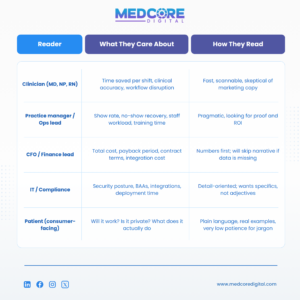
Strong healthtech content speaks to one of these readers per page, in their language, with their concerns front and center. Pages that try to address all five at once typically address none of them well. The fix isn’t to lower the technical floor everywhere; it’s to write the right page for the right reader.
The 5-Part Framework for Humanizing HealthTech Content
Across hundreds of healthtech pages we’ve audited at Medcore Digital, the same five moves separate content that connects from content that bounces. None of them require dumbing down the product. All of them require choosing the reader over the engineer.
1. Lead With the User Moment, Not the Feature
Open every page with a specific moment in the reader’s day where the product matters. Not the dashboard. Not the architecture. The moment.
Compare:
- Jargon-heavy: ‘Our HL7 FHIR-compliant interoperability layer enables real-time bidirectional data exchange across disparate EHR ecosystems.’
- Humanized: ‘When a patient is referred from the cardiologist back to their primary care physician, their full record arrives before the appointment, not after a week of phone tag.’
The humanized version doesn’t lose the technical substance; it just defers it. The technical reader still finds what they need below the fold. The non-technical reader stays past the first paragraph. And AI engines asked, ‘What does [product] do?’ Get a quotable, citation-ready answer instead of a string of acronyms they have to decode.
2. Translate Every Acronym on First Use
HealthTech runs on acronyms. Your product page probably has FHIR, HL7, EHR, EMR, PMS, RCM, BAA, PHI, HIPAA, HITRUST, NPI, CMS, MACRA, MIPS, and SOC 2 in the same paragraph. A clinician will recognize maybe half of those. A CFO will recognize three. A patient zero.
The rule: define every acronym in plain English the first time it appears, even if you think it’s obvious. Use this pattern:
- ‘…maintain HIPAA compliance (the federal rule that protects how patient data is collected and shared)…’
- ‘…integrates with your EHR (electronic health record system, like Epic or Athena)…’
- ‘…covered under your BAA (business associate agreement, the contract that binds vendors to HIPAA rules)…’
This adds 5–8 words per first-use definition. It saves the reader’s attention. It also gives AI engines clear definition blocks they can extract for ‘what is X’ queries, turning your content into a citation source for the entire category, not just your branded queries.
3. Anchor Features to Workflows, Not Specs
Features list what the product can do. Workflows show what the product does for the user. Non-technical readers buy on workflows every time.
Reframing exercise. For each feature on your product page, ask:
- Who uses this?
- When in their day does it come up?
- What was it like before our product?
- What’s it like now?
Example: ‘AI-powered triage.’ Run through the four questions:
- Who: front-desk receptionists
- When: every inbound call where a patient describes symptoms
- Before: receptionist guesses urgency, sometimes routes wrong, occasionally sends a heart-attack symptom to next-week scheduling
- After: structured triage prompts surface urgent symptoms in real time, route to the right service line, document the call
Now the feature has stakes. Now a practice manager reading the page can picture her front desk Monday morning. Now ChatGPT, summarizing your product, can quote a real-world use case instead of a marketing line.
4. Use Familiar-Industry Analogies
HealthTech concepts often have direct parallels in industries the reader already understands. Banking, ride-share, retail, telecom, and consumer SaaS all share patterns with healthcare technology, and a good analogy is worth two paragraphs of explanation.
Useful analogies that travel well:
- Interoperability is to healthcare what number portability was to telecom; your data moves with you when you change providers.
- FHIR APIs are like Plaid for healthcare, a standard pipe that lets one app talk to another without custom integration.
- Patient access portals are like online banking for your medical records, secure login, viewing what’s there, and messaging the front desk.
- RCM (revenue cycle management) is the financial supply chain of a practice, from claim submission to payer reimbursement to patient billing.
- Clinical decision support is like spell-check for diagnoses; it doesn’t replace the clinician, it catches things they might miss.
Use analogies sparingly and accurately. A wrong analogy is worse than no analogy. But a good one parks the concept in the reader’s existing mental furniture instantly.
5. Keep Clinician Review, Replace Clinician Voice
The most common over-correction we see: brands that simplify so aggressively they lose clinical accuracy. The fix isn’t to choose between accuracy and accessibility; it’s to separate the roles.
The workflow that consistently produces both:
- AI assists the draft based on technical source material (product docs, clinical specs, integration guides).
- A clinician reviews for accuracy; does this misrepresent how the product works in a clinical context? Does it overstate what’s automated vs. clinician-driven?
- A copy editor humanizes for voice; does this read like a marketing brochure or like a real person explaining something useful?
- The named author/reviewer attribution stays on the page, clinician name, credentials, and review date. This is the E-E-A-T signal that earns AI citations and patient trust.
AI healthcare content rule of thumb
AI is excellent at structure and first drafts. AI is poor at clinical nuance and human voice. The best healthtech content in 2026 uses AI to scale, never to replace, clinician review or human editorial judgment. Pages that ship without either layer get suppressed by Google’s Helpful Content system and excluded from AI Overview citations.
Practical Patterns: Content Blocks That Translate Across Audiences
Specific content patterns work harder than others when your reader population is mixed. These are the formats that consistently translate technical material into language that connects.
The Definition Block
A 40–60 word standalone explanation of a concept, written so it works without surrounding context. Definition blocks rank in featured snippets, get cited in AI Overviews, and rescue readers who landed on the page mid-confusion.
Template:
‘[Concept] is [plain-English definition in 15–25 words]. In healthcare specifically, it [practical application in one sentence]. For a [reader role], this means [outcome in one sentence].’
Worked example for ‘remote patient monitoring’:
‘Remote patient monitoring is a system that lets clinicians track patient health data, blood pressure, glucose, weight, and and heart rhythm between visits using connected devices at home. In healthcare specifically, it shifts care from episodic visits to continuous oversight for chronic conditions like diabetes and heart failure. For a primary care practice, this means catching patient deterioration days before it becomes an ER visit.’
The Before-and-After Block
Two short paragraphs side by side: one describing the workflow before the product, one after. This format outperforms feature lists for non-technical readers because it makes the change concrete.
Example for an automated prior-authorization tool:
- Before: ‘A medical assistant spends 20 minutes per case calling insurance, navigating phone trees, and refaxing documentation. Average turnaround: 4–7 days. About 12% of cases get denied for paperwork errors caught at the payer. ‘
- After: ‘The system pre-fills payer-specific forms from the EHR, submits electronically, and tracks status. Median turnaround drops to 36 hours. Paperwork-error denials fall by ~70% because the system flags missing fields before submission.’
Notice what’s happening: numbers replace adjectives. ‘Faster’ becomes ’36 hours.’ ‘Fewer errors’ becomes ‘~70% drop. ‘ Specifics outperform claims, both for human readers and AI citation logic.
The Comparison Table for Mixed Audiences
Comparison tables earn roughly 33% of all AI citations across categories, the single highest-citation format. For healthtech, build comparison tables that work on three axes simultaneously: clinical, operational, and financial. This serves the multi-stakeholder audience without writing three separate pages.
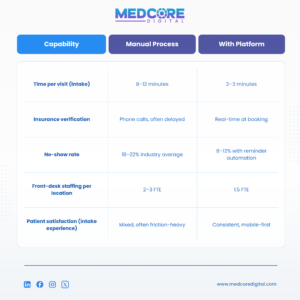
This single table does work for clinicians (visit time), operations leads (staffing), CFOs (FTE costs), and patients (satisfaction), without writing four versions of the same content.
The Story Block (Non-Technical Healthcare Storytelling)
A short narrative, 80–150 words, that follows one specific user through one specific moment with the product. Story blocks are how technical capabilities become emotionally resonant without becoming sappy.
Template:
‘[Specific user role] at [specific kind of practice] was [problem they faced before the product]. They [adopted the product / changed the workflow]. Within [timeframe], [specific measurable change]. The thing they didn’t expect: [unexpected secondary benefit].’
Worked example:
‘A practice manager at a 6-provider primary care group in suburban Texas was losing roughly an hour a day chasing prior authorizations across four payers. She rolled out the platform across three providers in week one, all six by week three. Within 30 days, her medical assistant team was reclaiming about five hours a week each. The thing she didn’t expect: the data trail surfaced two payers whose rejection rates were quietly tanking her revenue; both got renegotiated at the next contract cycle.’
This is real-feeling, role-specific, outcome-focused, and quotable. It also gives AI engines exactly the kind of detailed, attributable, scenario-rich content they preferentially cite over generic marketing copy.
AI Healthcare Content: Where AI Helps and Where It Fails
AI is now part of every healthtech content workflow. Used well, it makes humanization faster, drafts more readable copy, surfaces analogies, and structures content for extraction. Used poorly, it produces the exact unreadable, generic, factually shaky content that gets suppressed by Google and skipped by AI Overviews.
Where AI Helps
- Initial drafts from technical source material. Feed AI your product spec or feature doc and ask it to draft a non-technical explanation. The first pass will be 60% there, a useful starting point.
- Acronym translation passes. AI is excellent at flagging undefined acronyms and proposing plain-English alternatives.
- Reading-level adjustment. Ask AI to rewrite a passage ‘at an 8th-grade reading level without losing the technical accuracy.’This works almost always.
- Audience-specific variants. From one master draft, generate clinician-focused, ops-focused, and CFO-focused variants in minutes.
- Extracting quotable definitions. Ask AI to pull the 15–25 word definition from a longer passage. This is the format AI overviews cite.
Where AI Fails
- Clinical accuracy. AI fabricates plausible-sounding clinical claims with confidence. Every clinical statement needs human clinician review.
- Voice and authenticity. AI defaults to a flat, generic, slightly overconfident tone. A human editor has to pull this back to something that sounds like a real expert wrote it.
- Industry-specific nuance. AI doesn’t know that ‘denied for medical necessity’ means something different from ‘denied for missing documentation.’Subject-matter review is non-negotiable.
- Citing sources accurately. AI invents citations. Every statistic and source claim needs to be human-verified before publication.
- Original insight. AI summarizes existing material; it can’t generate the practice-specific outcome data, clinician observations, or patient stories that earn citations and trust.
The Reading-Level Standard for HealthTech Content
Across multiple studies, the optimal reading level for healthcare content sits at grade 8–9, even when the audience is primarily clinicians. The reason isn’t intelligence; it’s cognitive load. A clinician at the end of a 12-hour shift reads at a much lower comprehension level than the same clinician in a quiet office at 9 a.m. A lower reading level isn’t condescending; it’s respectful of attention.
Practical reading-level rules:
- Sentences average 15–20 words. Anything longer than 25 should be split unless there’s a structural reason it can’t be.
- Paragraphs cap at 3–4 sentences. On mobile, that’s already a wall of text. Anything denser gets skipped.
- Active voice 80%+ of the time. ‘The system flags duplicates’ beats ‘duplicates are flagged by the system. ‘
- One concept per sentence. Compound sentences with three nested ideas are where readers drop off.
- Use the Hemingway Editor or Grammarly readability score as a floor: target grade 9 or below for general content; grade 10–11 is acceptable for deep technical pages aimed at IT or clinical leads.
This doesn’t mean every sentence is short and choppy. Rhythm matters. Mix short, medium, and (occasionally) longer sentences to keep the prose from sounding mechanical. The goal is content that reads naturally, not content that reads like it was written for kids.
Story-Driven Healthtech Page Architecture
How you structure the page matters as much as how you write the prose. Non-technical healthcare storytelling works best when the page itself follows narrative logic, problem → tension → resolution → proof, instead of feature-list logic.
The Page Skeleton That Consistently Converts
- Hero with the user moment (2 sentences max). ‘When the patient calls back at 7 p.m., your front desk is closed, and the appointment slips.’Then the product’s role.
- Answer-first paragraph (40–60 words) explaining what the product is and who it’s for. This is what AI overviews extract.
- Before-and-after block showing the workflow change concretely. Numbers, not adjectives.
- How it works (3–5 numbered steps), each step described from the user’s perspective, not the system’s.
- Proof block: specific outcome data, named customer (with permission), or short story block.
- Comparison table (manual vs. platform, or vs. category) for the multi-stakeholder reader.
- FAQ section addressing the questions each stakeholder asks (clinical, operational, financial, and technical). Mark up with the FAQPage schema.
- Single, low-friction CTA. ‘Book a 15-minute walkthrough’ or ‘See how it works for [specialty]. ‘ Specific beats generic every time.
Skip nothing. Reorder based on which audience the page targets. But the eight-block structure consistently performs better than feature-list pages on conversion, on Google ranking, and on AI Overview citation eligibility.
Writing HealthTech Content That AI Engines Actually Cite
Humanizing content and optimizing for AI citation are not competing goals. They’re the same goal. AI engines preferentially cite content that’s clear, structured, well-attributed, and fluent, exactly the qualities that make content readable for non-technical humans.
The Princeton GEO Findings, Applied to HealthTech
Princeton’s Generative Engine Optimization research (KDD 2024) tested nine optimization methods across Perplexity and ranked them by visibility boost. The top three for healthtech are directly compatible with humanization:
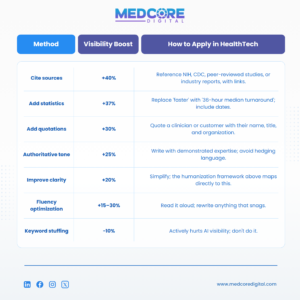
Combine fluency and statistics, and the visibility lift compounds; Princeton’s research found low-ranking sites can see up to a 115% AI visibility increase with this combination. For healthtech specifically, that means every page should have at least three citable statistics with sources, two named expert quotes, and an answer-first paragraph below the grade-9 reading level.
HealthTech Schema That Earns AI Citations
Add structured data to every healthtech page so AI engines can confirm what your content covers. The schema types that matter most:
- SoftwareApplication or Product for product pages, captures category, features, price tier, and ratings.
- Article or BlogPosting for educational content, author, date, and topic.
- FAQPage for FAQ sections, direct Q&A extraction by AI.
- HowTo for setup/integration guides, step extraction for process queries.
- Organization for the parent company, entity recognition, and trust signals.
- Review and AggregateRating where you have customer reviews and feed AI’s trust evaluation.
Schema-marked pages show 30–40% higher AI visibility on average. For B2B healthtech, the highest-leverage addition is usually the FAQPage schema on every product and category page; it’s the schema AI Overviews and ChatGPT extract from most directly.
Common Mistakes That Make HealthTech Content Feel Inhuman
- Leading with the platform, not the user. ‘Our cloud-native architecture’ instead of ‘When your front desk gets buried at 9 a.m’
- Acronym walls. Five acronyms in the same paragraph with no definitions. The reader gives up.
- Feature lists with no workflow context. Bullet points of capabilities without explaining who uses them or when.
- AI-generated copy without human editing. It reads flat, factually shaky, and identical to every competitor’s AI-generated copy.
- Hedged language. ‘May potentially help reduce’ instead of ‘cuts time per case from 20 to 4 minutes.’ Hedging signals weak claims.
- Stock photography instead of real screenshots. Smiling-clinician-with-tablet stock kills credibility. Real product UI builds it.
- No reading-level discipline. Pages averaging grade-13 prose for an audience that won’t read past paragraph two.
- Generic case studies. ‘A leading regional health system saw significant improvements. ‘Useless. Name them, quantify it, or skip it.
- Skipping the ‘who is this for’ line. If a reader can’t tell within 10 seconds whether your product is for them, they leave.