
The Psychology of Trust in Healthcare Marketing
Trust is the cornerstone of every patient-provider relationship. In digital spaces, where 93% of healthcare journeys begin online, understanding healthcare consumer behavior becomes essential for building credibility in healthcare marketing. Patients do not choose doctors solely on price or proximity; they select those they believe will keep them safe.
This guide unpacks the psychological triggers that convert skepticism into loyalty, revealing how a strategic healthcare digital marketing strategy and thoughtful content formats healthcare audiences crave can turn browsers into lifelong patients.
Why Trust Is Harder to Earn Online
Healthcare decisions carry emotional weight. A search for “chest pain treatment” is not casual browsing; it is a moment of vulnerability. Traditional trust cues eye contact, a firm handshake, and a calm voice, are absent online. In their place: website design, response speed, review authenticity, and content depth.
Psychological studies show that perceived risk drives healthcare consumer behavior more than any other industry. Patients fear misdiagnosis, unnecessary procedures, or privacy breaches. To counter this, every digital touchpoint must signal safety, competence, and empathy. Google’s E-E-A-T framework aligns perfectly with this human need, rewarding sites that demonstrate real-world experience and reliability.
The 5 Core Psychological Drivers of Patient Trust
Decades of behavioral research reveal five non-negotiable triggers in healthcare decision-making.
1. Social Proof: “Others Like Me Trust This Provider”
Patients mirror the actions of peers. A single detailed review, “Dr. Lee explained my MRI in plain English and called me personally with results,” outweighs ten generic five-star ratings.
Actionable Insight: Curate 3–5 patient stories per service page, focusing on emotional outcomes: relief, clarity, hope. Use video testimonials with captions for maximum impact.
2. Authority: “This Team Knows What They’re Doing”
Credentials matter, but contextualized credentials convert. A board certification listed alone is forgettable. A physician bio stating, “Dr. Patel has performed 2,800 successful cataract surgeries and trains residents at Johns Hopkins,” is memorable.
Actionable Insight: Embed micro-credentials in content cite studies, mention hospital affiliations, and include “As seen in” badges from local news.
3. Consistency: “This Practice Walks the Talk”
Inconsistent messaging erodes trust faster than bad reviews. A website claiming “same-day appointments” but with a contact form that takes 48 hours to respond creates cognitive dissonance.
Actionable Insight: Align every channel website, Google Business Profile, email, and social with an identical tone, hours, and promises. Medcore Digital synchronizes messaging across 50+ platforms to eliminate trust leaks.
4. Transparency: “I Know Exactly What to Expect”
Fear of the unknown paralyzes action. Patients want pricing ranges, procedure timelines, and recovery realities before calling.
Actionable Insight: Create “What to Expect” guides for every major service. Example: “Your First Visit to Our Sleep Clinic: A 7-Step Timeline” with photos of the facility and staff introductions.
5. Reciprocity: “They Gave Me Something Valuable First”
The principle of give-to-get is powerful in healthcare. A free “Pre-Diabetes Risk Calculator” or “7-Day Post-Op Meal Plan” creates obligation and positions your practice as a helper, not a seller.
Actionable Insight: Gate high-value content behind simple email capture (name + email only). Follow up with nurture sequences that educate, never hard-sell.
Content Formats Healthcare Consumers Trust Most
Format influences perception. The same message, whether in a blog or a physician-led video, triggers different trust pathways.
Physician-Led Video (Highest Trust)
The human face activates mirror neurons, so patients literally feel the doctor’s empathy. A 2-minute clip of Dr. Nguyen drawing a simple diagram of acid reflux triggers outperforms a 2,000-word article.
Best Practices:
- Film in exam rooms (not studios)
- Use natural lighting and white coats
- Speak directly to the camera: “If you’re experiencing this, here’s what it means…”
- Add transcripts and schema for SEO
Interactive Tools (High Engagement)
Patients trust providers who empower them. A “Should I Go to Urgent Care?” quiz with branching logic (fever + cough → pediatrician recommendation) builds authority through utility.
Long-Form Guides (Deep Trust)
For complex conditions, cancer, infertility, and chronic pain patients need depth. A 3,000-word guide with physician commentary, patient FAQs, and downloadable checklists satisfies both emotional and intellectual needs.
Email Nurture Series (Relational Trust)
Trust grows over time. A 5-email post-download sequence, “Day 1: Understanding Your Diagnosis” and “Day 3: Questions to Ask Your Doctor,” turns one-time visitors into advocates.
Medcore Digital designs multi-format content funnels that guide patients from anxiety to appointment, increasing conversion rates by 60%.
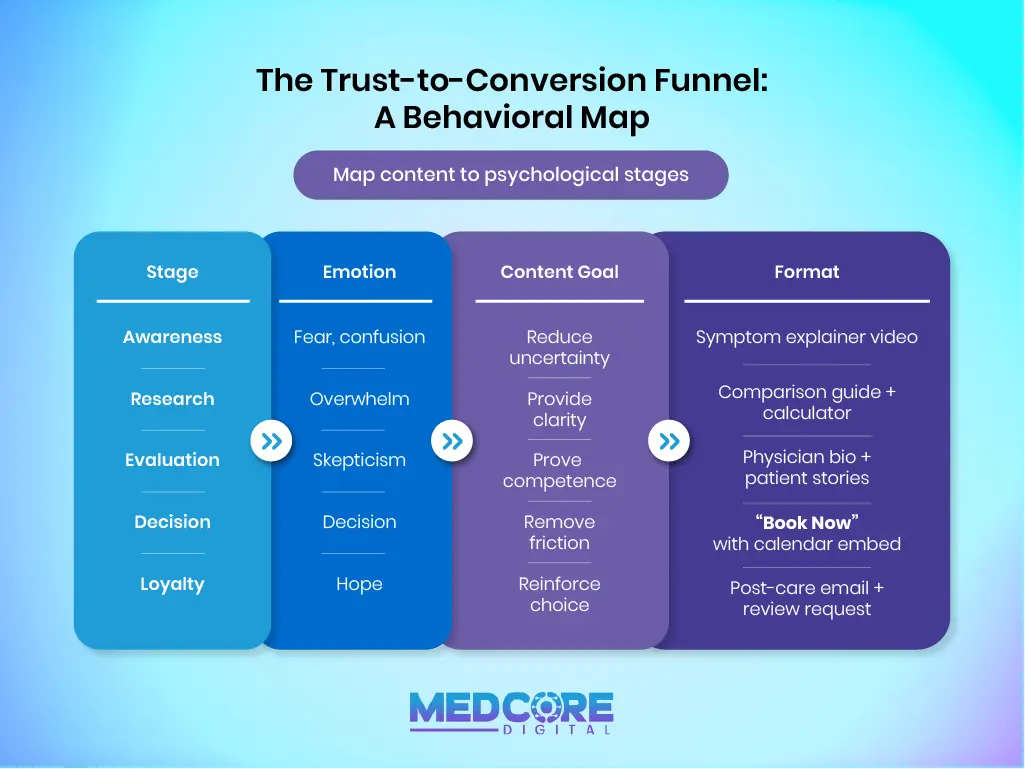
Building Credibility in Healthcare Marketing: The 90-Day Trust Blueprint
Month 1: Foundation
- Audit all trust signals (bios, reviews, response times)
- Film 3 physician intro videos
- Optimize Google Business Profile with Q&A
Month 2: Authority
- Publish 2 long-form guides with physician bylines
- Launch 1 interactive tool
- Secure 1 local media mention
Month 3: Connection
- Roll out email nurture series
- Embed video testimonials on key pages
- Train staff on review response scripts
Practices following this blueprint see trust metrics, branded searches, direct traffic, and review velocity rise 40–70% in 90 days.
The Neuroscience of First Impressions Online
Patients form judgments in 50 milliseconds. Optimize for the primacy effect:
- Hero image: smiling physician with patient (not stock photo)
- Headline: benefit-focused (“Get Clarity on Your Symptoms in 24 Hours”)
- Subheadline: social proof (“4.9 Stars from 850+ Patients”)
A/B tests show trust-optimized above-the-fold content increases form fills by 35%.
Overcoming Digital Trust Barriers
Barrier: “All doctors say the same thing.”
→ Differentiate with specificity. Instead of “compassionate care,” say “we call every patient personally with biopsy results within 24 hours.”
Barrier: “I don’t know if they accept my insurance.”
→ Add an insurance checker tool and list top plans on every page.
Barrier: “What if I have a bad experience?”
→ Showcase your review response policy: “Every concern is addressed by our medical director within one business day.”
Medcore Digital eliminates these friction points through behavioral audits and conversion-focused design.
Measuring Trust in Data
Trust is not abstract. Track:
- Branded search volume (+30% = growing mindshare)
- Direct traffic (patients typing your URL)
- Review sentiment score (via NLP tools)
- Appointment no-show rate (lower = higher pre-visit trust)
Correlate content performance with trust KPIs. A video with 10,000 views that drives 47 appointments has a measurable trust ROI.
The Future of Trust-Driven Healthcare Marketing
AI will summarize content, but it cannot replicate human connection. The practices that win will blend psychological precision with digital scale, using content formats healthcare consumers trust to deliver empathy at every touchpoint.
Medcore Digital has decoded healthcare consumer behavior for 15 years, helping over 400 providers turn digital doubt into unbreakable patient bonds. Start your trust transformation today.