
Most healthcare practices treat patient feedback like weather — something that happens to them. They check the rating once a week, panic about a one-star, and move on. Meanwhile, the practice down the street is using the same reviews to fill its schedule, train its front desk, fuel its ads, and rank in AI Overviews.
The gap between those two practices isn’t talent or budget. It’s whether they treat feedback as a passive scoreboard or as an active system. In 2026, with 96% of patients saying online reviews influence their provider choice and AI engines now using review summaries to recommend practices, the difference between those two postures is the difference between booked appointments and empty exam rooms.
This is the MedCore Digital playbook for converting patient feedback healthcare into measurable reputation and revenue. It covers the math behind why reviews drive decisions, the HIPAA-compliant engine for collecting and responding to them, and — crucially — how to repurpose feedback into marketing campaigns that actually move patient volume.
Why Patient Feedback Is More Than Reputation
Reputation is the surface. Underneath, every patient review is doing five jobs at once — and most healthcare brands only see one of them.
- Conversion: Patients researching your practice are reading reviews before they call. The rating, the volume, the recency, and the response quality decide whether they book.
- Local SEO: Google’s local pack algorithm now weighs review velocity (steady inflow), recency (last 60–90 days), keyword content within reviews, and your response rate. A stagnant review profile reads as a stagnant practice.
- AI Overview citations: Roughly 26% of patients have already been directly influenced by an AI-generated review summary. ChatGPT, Perplexity, and Google AI Overviews lean heavily on aggregated review content when recommending providers.
- Operational intelligence: Reviews surface the exact patterns your front desk, schedulers, and clinical teams need to know about — wait times, communication gaps, billing surprises — long before they show up in a patient survey.
- Marketing creative: A real patient saying ‘they explained everything in plain English and didn’t rush me’ is more persuasive than any headline a copywriter will ever write. Authorized testimonials are the highest-converting ad creative in healthcare, full stop.
Practices that act on all five pull ahead. Practices that only watch the star rating drift backward, even when the rating itself looks fine.
Why Reviews Influence Healthcare Decisions More Than Any Other Industry
Healthcare buying isn’t like buying a router. Patients are choosing someone to put their hands on their body, prescribe medications they don’t fully understand, and access information that could affect their employability. The decision is high-stakes, low-information, and emotionally loaded. Reviews are the closest thing to a stranger’s verdict — and patients lean on them harder than in any other category.
The numbers from 2026 research:
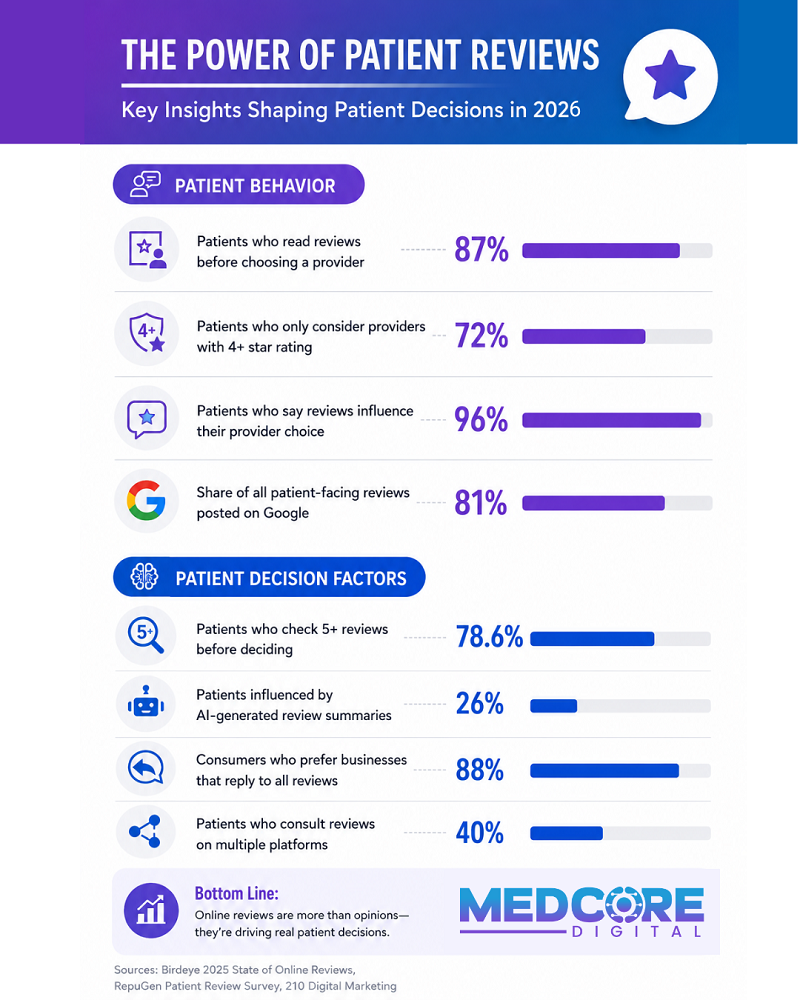
Sources: Birdeye 2025 State of Online Reviews, RepuGen Patient Review Survey, 210 Digital Marketing 2026 Healthcare Trends Report.
Three patterns inside this data matter more than the headline numbers:
- Recency now outweighs quantity. A 4.9-star practice with 40 reviews from the last 90 days routinely outperforms a 4.6-star practice sitting on 400 reviews from three years ago. Google’s local algorithm treats steady recent reviews as a signal of active, high-quality care.
- Patients triangulate across platforms. Google is the anchor, but 40% of patients also check Healthgrades, Vitals, Zocdoc, WebMD, or Yelp before booking. A clean Google profile and a stale Healthgrades profile is a leak point.
- Response rate is its own ranking signal. Google now moderates response quality and uses response rate (not just response presence) as a local pack input. 88% of consumers prefer businesses that reply to every review — patients notice.
Where Healthcare Reviews Actually Live in 2026
Hospital reputation management used to mean Google and maybe Healthgrades. The 2026 reality is messier. Reviews now feed eight surfaces simultaneously, each with its own logic.
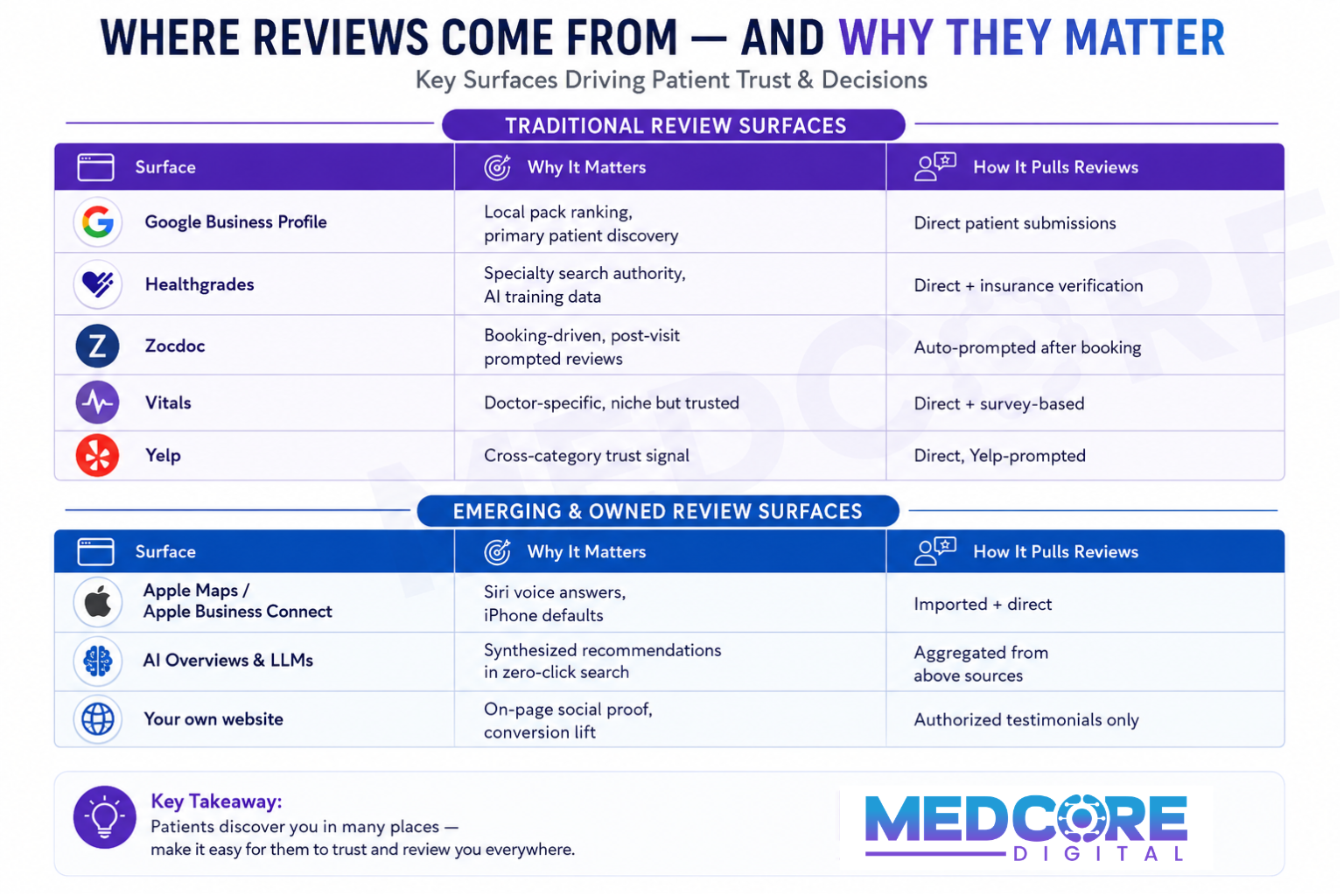
| Why this matters operationally When a patient asks ChatGPT ‘best orthopedic surgeon in Plano who takes Aetna,’ the model is not reading your website. It’s reading a synthesis of your Google reviews, your Healthgrades profile, your Zocdoc bookings, your Vitals ratings, and Reddit threads about your practice. A clean profile on five of six and a neglected sixth is enough to disqualify you from the recommendation. |
Building a HIPAA-Compliant Patient Review Engine
Healthcare reputation management is genuinely harder than other industries because every well-meaning instinct can become a HIPAA violation. Saying ‘thanks for coming in’ in a public review response confirms the reviewer is a patient — which is enough to trigger an OCR investigation. One healthcare organization paid a $25,000 fine plus three years of restrictions for posting patient images and PHI on its website. The rules are real, and they’re enforced.
Here’s how to build a feedback system that grows reviews without exposing the practice.
1. Automated Collection (the volume engine)
- Trigger window: Send the review request 24–72 hours after the appointment via SMS or email. Earlier is too soon (the patient hasn’t processed the visit), later is too late (the moment has passed).
- One platform per ask: Mention only one platform per request (Google for most, Healthgrades for specialty practices). Splitting attention across platforms cuts response rate in half.
- One-tap link: Use Google’s place ID review link or Healthgrades’ direct review URL. Every additional click loses 30–50% of would-be reviewers.
- EHR/PMS integration: Pull the trigger from completed appointment events in your EHR (Epic, Athena, Cerner) or PMS — never from a marketing list. This keeps the workflow inside the BAA boundary.
- BAA-backed tooling: Use platforms with signed Business Associate Agreements (Birdeye, RepuGen, Solutionreach, DoctorConnect, Reputation.com). Standard SMS or email tools without BAAs are a compliance risk.
2. HIPAA-Safe Response Templates
The single rule: never confirm in a public response that the reviewer is your patient. Even harmless phrasing like ‘thanks for coming in’ or ‘glad we could help with your knee’ is a violation.
Compliant response templates:
- For positive reviews: ‘Thank you for taking the time to share this feedback. We’re committed to providing every visitor to our practice with a great experience.’
- For negative reviews: ‘We take all feedback seriously. We’d appreciate the opportunity to address your concerns directly — please contact our office manager at +1 (409) 419-3597 or via secure form.
- For ambiguous reviews: ‘Thank you for sharing your experience. We strive to improve every day, and feedback helps us do that.’
None of these confirms a relationship. None acknowledges treatment. All preserve the practice’s voice and signal that someone is paying attention.
3. The Authorization Workflow for Featured Testimonials
Public reviews are one thing. Pulling a quote, a name, or a face onto your website, social, or paid ad is a different category — and it requires explicit, documented HIPAA authorization. The Tebra and Compliancy Group standards in 2026 are clear: a separate authorization document, not buried in intake forms, that specifies the why, what, where, and how-to-revoke.
A compliant authorization captures:
- Patient identity (name, date)
- Specific content covered (quote, photo, video, treatment details)
- Specific channels (website, social media, paid ads, email, print)
- Time-bound usage (typically two years, then re-authorization)
- Right to revoke and instructions on how to revoke
- Non-clinical staff handling the conversation, so patients don’t feel pressured by a clinician
| What goes wrong without it A satisfied patient leaves a glowing five-star review. The marketing manager screenshots it for the website. The patient sees the screenshot and asks for it to come down — they didn’t realize a Google review would end up on the homepage. Now you have an OCR complaint, an authorization gap, and a viral social moment. All preventable with a 30-second authorization workflow. |
Turning Reviews into Marketing Campaigns That Actually Move Volume
Most practices stop at ‘we have a 4.7 star rating’. The brands compounding in 2026 are systematically repurposing authorized feedback into seven different marketing assets. Each one earns its place because it converts better than what would otherwise sit in that slot.
1. On-Site Social Proof Blocks
Replace stock ‘happy patient’ images with authorized quote cards above the fold of every service and provider page. Pages with embedded patient quotes convert 15–25% better than identical pages without them. Pull the quote, attribute by first name and last initial only (with authorization), and rotate quarterly.
2. Provider-Page Highlight Reels
Each provider page should feature 2–4 quotes specifically about that provider — not the practice as a whole. Patients searching for ‘Dr. Patel cardiologist Dallas’ want to know what other patients said about Dr. Patel. Generic clinic praise doesn’t move the needle on a provider page; provider-specific praise does.
3. Short-Form Video Testimonials
Provider-led short video where an authorized patient says, in their own words, what changed after treatment is the highest-converting healthcare ad creative in 2026. 30–60 seconds, vertical format, subtitled. Distribute on Instagram Reels first, then YouTube Shorts and TikTok. Practices publishing 2–4 patient story videos per week consistently outperform those running standard service ads.
4. Paid Ad Creative Built From Reviews
Pull recurring themes from authorized reviews — ‘didn’t rush me’, ‘finally got answers’, ‘felt heard for the first time’ — and use them as ad headlines and copy variants. Real patient language outperforms agency copy almost universally. Test five review-based ad variants against one polished ‘professional’ version and watch the review-based ones win.
5. Sales Enablement and Insurance Network Decks
Hospital and multi-location systems negotiate with payers and referring providers all year. A leave-behind that includes Net Promoter Score, sentiment trend, and authorized patient quotes tied to specific service lines closes referral conversations faster than a slide of clinical credentials alone.
6. Email Nurture Sequences
Patient reactivation emails for 12-month dormant patients perform 2–3x better when they include a recent patient story near the top. The story re-establishes credibility and gives a wavering patient a reason to come back without feeling sold to.
7. AI-Optimized Reputation Pages
Build a dedicated ‘Patient Stories’ page on your site with structured testimonials, FAQ schema, and Review schema markup. AI engines scrape these pages aggressively when surfacing recommendations — having a page that consolidates authorized testimonials with proper schema feeds your citations across ChatGPT, Perplexity, Gemini, and AI Overviews directly.
Why Patient Reviews Matter for Hospitals (and What Multi-Location Adds)
For a single-provider clinic, reputation management is one workflow. For a hospital or a 50-location specialty group, it’s a system. Multi-location healthcare reputation management has to clear three bars that smaller practices don’t even see.
1. Location-Level Granularity
Each location, each department, and each high-profile provider needs its own dashboard view. A hospital with a 4.8 average might have one urgent care location at 3.7 dragging the system down — and the only way to see that is location-level reporting, not aggregate.
Healthy multi-location systems track: average rating by location, review velocity by location, response rate by location, response time by location, and sentiment by department (front desk, nursing, billing, clinical care). When one of these falls behind, a system-level dashboard surfaces it within a week instead of letting it compound for a quarter.
2. Brand Consistency at Scale
Multi-location systems leak trust when one clinic sounds professional in its review responses and another sounds defensive or absent. The fix is centralized response policy, location-trained staff, and AI-assisted draft responses that keep brand voice consistent without sounding scripted.
Modern hospital reputation management platforms (Reputation.com, Birdeye, RepuGen, Solutionreach) use AI to draft responses tuned to each review’s sentiment and details, which the local team then approves or edits. This reduces response time from days to hours and keeps the system’s voice unified.
3. Cross-Location Service Recovery
Negative reviews flagged in real time have to route to the right team — not the marketing inbox. A complaint about wait times goes to the practice manager. A complaint about billing goes to the revenue cycle team. A complaint about clinical care goes to the medical director and risk management. Five of the top ten U.S. health systems run service recovery loops that close the loop with the patient within 48 hours, often converting a 1-star complaint into a 4-star follow-up.
Mining Feedback for Operational Insight (Where the Real Revenue Lift Lives)
The most overlooked use of patient feedback isn’t marketing at all. It’s operations. Reviews surface the exact friction points that quietly drag CPAP up and patient lifetime value down — wait times, billing surprises, communication breakdowns, scheduling friction. Practices that mine feedback for ops signals see 15–25% improvements in show rates, retention, and front-desk conversion without any additional ad spend.
The Sentiment-to-Operations Loop
- Tag every review by topic (front desk, scheduling, wait time, billing, clinical care, communication, telehealth experience). AI sentiment analysis tools handle this automatically.
- Track topic frequency monthly and watch for emerging themes — three negative mentions of ‘phone hold time’ in a single month is a fixable problem before it becomes a rating drop.
- Route topics to owners: wait time issues to operations, billing complaints to revenue cycle, communication concerns to provider training.
- Close the loop publicly by responding to the original review when the issue is fixed — ‘We’ve added Saturday hours and a same-day callback line — thank you for the feedback.’ This signals to future patients that you act on what you hear.
This is where ‘patient feedback healthcare’ stops being a marketing exercise and becomes a continuous improvement engine. The practices that get this right find that their marketing budget works harder because the underlying experience is better — patients show up, stay, refer, and review.
The Patient Feedback Audit: Where to Start
If your healthcare brand has never run a structured reputation audit, here’s the 12-point framework to start with. Most practices score themselves 4–6 out of 12 on the first pass — and every fix moves the needle on visibility, conversion, or both.
- Is your Google Business Profile claimed, verified, and optimized for every location?
- Is your average rating 4.5+ across Google, Healthgrades, and at least one specialty platform?
- Are you collecting at least 8–15 new reviews per location per month, with steady velocity?
- Are you responding to 100% of reviews — positive and negative — within 24 hours?
- Do your responses use HIPAA-safe language that never confirms patient status?
- Do you have signed authorization forms for every featured testimonial on your website, social, and ads?
- Are you running a BAA-backed review automation platform integrated with your EHR/PMS?
- Is your Healthgrades, Zocdoc, Vitals, and Apple Business Connect data identical to your Google profile (NAP consistency)?
- Do you tag and track sentiment by topic — and route operational issues to the right owner?
- Do you publish a dedicated ‘Patient Stories’ page with Review schema markup?
- Do you repurpose authorized reviews into at least three marketing channels (web, video, paid ads)?
- Do you report review velocity, response rate, and sentiment trend to leadership monthly — alongside CPAP and LTV?
| What ‘good’ looks like in 2026 A high-performing healthcare brand scores 11–12 out of 12, runs a quarterly review of the system, and has a single owner accountable for the reputation loop. Reputation has moved from ‘something marketing handles’ to a board-level operational metric in the practices growing fastest. If yours hasn’t, that’s the first thing to fix. |
Common Mistakes That Quietly Drain Reputation and Revenue
- Asking for reviews on multiple platforms in the same message. Cuts response rate in half. Pick one.
- Responding to a review with ‘thanks for coming in.’ HIPAA violation — confirms patient status.
- Posting a screenshot of a Google review on Instagram without authorization. Public review and authorized testimonial are different categories.
- Letting negative reviews sit unanswered. Future patients read response patterns, not just ratings.
- Treating the rating as the whole metric. Velocity, recency, response rate, and keyword content all matter independently.
- Centralizing review collection but not response. A delayed centralized response loses the moment; local empowerment with a brand-voice playbook works better.
- Ignoring Healthgrades and Apple Maps because Google is dominant. AI engines triangulate. A clean Google profile and a stale specialty profile is enough to disqualify you from a citation.
- Reporting ‘star rating’ to leadership and nothing else. Train the C-suite to ask about review velocity, response rate, and sentiment by topic — not just the headline number.
Frequently Asked Questions
How can healthcare practices use patient reviews for marketing without violating HIPAA?
Two rules: never confirm in a public response that someone is your patient (use HIPAA-safe templates that thank the reviewer without acknowledging treatment), and never repurpose a review into a website, ad, or social asset without a separate signed HIPAA authorization that covers the specific content, channels, and time-bound use. Public reviews left by patients are the patient’s speech and don’t violate HIPAA on their own — but anything the practice does with them does.
How many reviews does a healthcare practice need to compete?
The 2026 benchmark is 50+ reviews on Google with a 4.5+ rating, plus active profiles on at least two specialty platforms (Healthgrades, Zocdoc, Vitals). But review velocity matters more than total count — a practice generating 8–15 fresh reviews per location per month outperforms a practice with 400 reviews from three years ago. Recency now drives ranking and AI Overview citation eligibility more than volume.
Can a healthcare provider respond to a negative patient review?
Yes — and they should. Silence reads as guilt or indifference. The compliant approach is to respond publicly with a HIPAA-safe template that acknowledges the feedback, expresses care for patient experience, and invites the patient to a private channel: ‘We take all feedback seriously. We’d appreciate the opportunity to address your concerns directly — please contact our office manager at (XXX) XXX-XXXX.’ Never confirm patient status, never reference treatment, never argue the facts publicly.
What’s the best HIPAA-compliant patient review platform?
Top BAA-backed platforms for healthcare in 2026 are Birdeye, Reputation.com, RepuGen, Solutionreach, and DoctorConnect’s CARE AI Survey System. Selection criteria: signed BAA, EHR/PMS integration depth, multi-location dashboards, AI-assisted response drafting, and sentiment analysis by topic. Avoid generic review tools without a BAA — they create compliance exposure on every patient interaction.
How quickly should we respond to patient reviews?
Within 24 hours, every time. Google now uses response rate as a local pack ranking signal, and 88% of consumers prefer businesses that reply to all reviews. For negative reviews, faster is better — service recovery within 48 hours frequently converts a 1-star complaint into a 4-star follow-up review once the issue is resolved.
How do AI Overviews and ChatGPT use patient reviews?
AI engines synthesize reviews from Google, Healthgrades, Zocdoc, Vitals, Yelp, and forum discussions to build a recommendation about a provider. They look at average sentiment, recurring themes (was the front desk friendly? did the provider listen?), recency, and the practice’s response patterns. A practice with strong reviews on Google but stale or missing profiles on specialty platforms will be passed over in favor of a competitor with consistent presence across all sources. Cross-platform consistency is now an AI ranking signal.
Should each provider have their own review profile, or is the practice profile enough?
Both. Patients searching for a specific physician (often by name) read provider-level reviews; patients searching for a service or location read practice-level reviews. Most multi-provider practices need: a Google Business Profile per location, a Healthgrades or Vitals profile per provider, and provider-specific testimonials on each provider page. Solo practitioners can collapse this into a single profile, but anyone running 2+ providers should split it.
The Bottom Line
Patient feedback is the single most undervalued asset on most healthcare marketing dashboards. It influences 96% of provider decisions, feeds local pack rankings, fuels AI Overview citations, generates the highest-converting ad creative your team will ever run, and surfaces operational fixes that lift retention without spending another marketing dollar. And most of it is free — patients are already writing the reviews. The job is to collect more, respond to all of them, repurpose the authorized ones, and mine the rest for what they’re telling you about how the practice actually feels from the patient’s seat.
The brands turning feedback into reputation and revenue in 2026 share a habit. They treat reviews as an operating system, not a vanity metric. They run a HIPAA-compliant collection engine, a 24-hour response loop, a quarterly authorization workflow for testimonials, a monthly sentiment review for operations, and a review-fueled creative pipeline for marketing. Every part of that compounds. None of it costs more than discipline.
If you don’t know your review velocity, response rate, and sentiment-by-topic — or if your team is still pasting Google reviews to Instagram without authorization — that’s where to start. MedCore Digital runs healthcare reputation audits that benchmark every dimension above and rebuild the feedback engine end-to-end. Get in touch at Medcore Digital.
About MedCore Digital
MedCore Digital is a healthcare-focused SEO and growth agency. We help hospitals, multi-location practices, urgent care groups, and specialty clinics turn patient feedback, search visibility, and AI-powered discovery into measurable revenue growth — built on HIPAA-compliant systems, clinician-led content, and the operational discipline of running a real reputation engine.