
Most healthcare websites are technically correct and strategically wrong. They publish accurate clinical content, optimize for the keywords their physicians use, and watch traffic stagnate while WebMD, Reddit, and a handful of national directories take the actual patient queries. The disconnect isn’t quality — it’s language. Patients don’t search the way clinicians write.
In 2026, the gap between what providers publish and what patients actually search for has become the largest single source of missed patient acquisition in healthcare marketing. AI Overviews now answer roughly 60% of health queries without a click, and the practices winning the citations inside those answers are the ones who structured their content around real patient language and unmet question categories. The rest are losing — quietly, but compounding.
This is the Medcore Digital playbook for finding and filling healthcare content gaps. It covers how to map patient search intent in healthcare, the categories where coverage is thinnest, the keyword research methodology that surfaces them, and how to structure new content so it earns rankings, AI citations, and booked appointments.
The Patient-Language Gap: Why Most Healthcare Content Misses Real Search Intent
Patients search in plain, everyday language. Clinicians write in clinical terminology. This gap is the single largest reason healthcare websites underperform in organic search. A patient with chest pain doesn’t search ‘angina pectoris differential diagnosis’ — they search ‘why does my chest hurt when I climb stairs.’ A practice that publishes content optimized for the first phrase ranks for nothing the patient is actually typing.
Three patterns define how patients actually search for healthcare in 2026:
- Symptoms before diagnoses. Patients describe what they feel, not what it might be. ‘Sharp pain in lower right abdomen’ outperforms ‘appendicitis symptoms’ by 4–6x in real search volume.
- Questions, not nouns. Roughly 70% of voice queries and a growing share of typed queries are phrased as full questions (‘how long does a knee replacement last?’), driven by voice assistants and conversational LLM interfaces.
- Cost and access first, clinical detail second. Patient research now starts with affordability. According to KFF, two-thirds of U.S. adults (66%) say they’re worried about affording healthcare in 2026 — the top financial worry across every demographic.
Healthcare brands that ignore these patterns end up with technically excellent content that ranks for nothing patients type. The fix is structural — re-anchor the content around how patients actually phrase their need, not around how clinicians describe the diagnosis.
| The simplest patient-language test Pull the top 25 questions your front desk and intake team field every week. That’s your real keyword list — phrased the way patients phrase it. Forum posts on Reddit (r/medical, r/AskDocs, condition-specific subs) are the second-best source: questions people post in long-form on forums are nearly identical to what they later ask LLMs. Write content that answers those exact questions, in those exact words. |
The 7 Biggest Content Gap Categories in Healthcare Marketing
Across hundreds of healthcare site audits we’ve run at Medcore Digital, the same seven content categories repeatedly show high search demand and low provider-side coverage. National sites (WebMD, Mayo, Healthline) and Reddit own most of these queries today — but their content is generic, while a local provider can win with specific, attributable, location-aware answers.
Gap 1: Cost and Insurance Content
This is the largest and fastest-growing content gap in 2026. Marketplace premiums rose 58% from $113/month in 2025 to $178/month in 2026 after federal subsidy enhancements expired, and search behavior has shifted in lockstep. Search interest in ‘cheap health insurance’ rose over 160% between early 2025 and early 2026, while ‘cost of health insurance’ more than doubled and ‘health care subsidy’ nearly tripled.
High-demand cost queries that most provider sites don’t address:
- ‘How much does an MRI cost without insurance?’
- ‘Does [practice name] take Aetna / BlueCross / Cigna / Medicare Advantage?’
- ‘How much is a [specialty] visit out of pocket?’
- ‘What is the cash price for [procedure]?’
- ‘Do you offer payment plans / sliding scale fees?’
- ‘Does my insurance cover [specific test or procedure]?’
Provider sites that publish clear, specific cost and insurance content win disproportionate visibility because national sites can’t be specific to a local practice and most local practices stay silent. A simple ‘Insurance & Pricing’ pillar page with verified, dated information often becomes a top-3 ranking page within 60 days.
Gap 2: Symptom-Stage Content (Pre-Diagnosis)
Most provider sites jump straight from service descriptions to booking. They skip the stage where the patient is researching what’s wrong with them — which is the stage where the patient’s relationship with a practice actually starts. Symptom-stage content is dominated by WebMD, Mayo Clinic, and Healthline because few local providers compete here. That’s an opportunity, not a closed door.
High-volume symptom queries underserved by local providers:
- ‘Why does [body part] hurt when [activity]?’
- ‘When should I see a doctor for [symptom]?’
- ‘Is [symptom] serious / dangerous / an emergency?’
- ‘How long should [symptom] last before I worry?’
- ‘What does it mean when [symptom + descriptor]?’
A local cardiology practice publishing ‘When should I see a cardiologist for chest pain?’ with a clinician byline, citations, and a clear next-step CTA can outrank generic national content for the local search variant — because Google rewards local relevance plus E-E-A-T over generic high-traffic content for medical queries.
Gap 3: Procedure Recovery and ‘What to Expect’ Content
Patients researching surgery don’t want one more page about what the procedure is. They want to know what the next two weeks of their life will look like. ‘How to’ and ‘what to expect’ queries consistently outvolume ‘what is’ queries by 3–5x for major procedures, but most surgical practices publish only the ‘what is’ page.
Underserved procedure queries:
- ‘How long does [procedure] recovery take week by week?’
- ‘When can I drive after [procedure]?’
- ‘What can I eat after [procedure]?’
- ‘How long is [procedure] hospital stay?’
- ‘Will I need physical therapy after [procedure]?’
- ‘What are the worst days of [procedure] recovery?’
- ‘When can I return to work after [procedure]?’
These pages convert at higher rates than condition pages because they reach patients in active decision mode — the patient is comparing surgeons, not researching a diagnosis. A specific, week-by-week recovery timeline page is one of the highest-converting page types in healthcare content marketing.
Gap 4: Doctor Selection and Comparison Content
Patients use comparison logic to choose providers, and they search comparison terms accordingly. Most healthcare sites don’t publish comparison content because it feels promotional — but skipping it means ceding the query to directories and AI Overviews that decide the comparison without you.
Underserved comparison queries:
- ‘How to choose a [specialty] doctor’
- ‘Questions to ask a [specialist] before surgery’
- ‘[Specialty A] vs. [Specialty B] for [condition]’
- ‘When to see a specialist vs. primary care for [condition]’
- ‘Best questions to ask before [procedure]’
These pages are about the patient’s decision process, not the practice. That’s exactly why they earn citations from AI engines — they read as patient-helpful, not vendor-promotional. Comparison content earns roughly 33% of all AI citations across categories — the single highest citation-share format.
Gap 5: ‘Accepting New Patients’ and Access Content
After cost, the second largest 2026 access concern is provider availability. Wait times, network adequacy, and ‘who’s actually taking new patients’ have become real barriers in many specialties. Patients now search this directly — and most practice sites don’t answer.
Underserved access queries:
- ‘[Specialty] doctor accepting new patients near me’
- ‘How long is the wait for a [specialty] appointment?’
- ‘[Practice name] same-day appointments’
- ‘Walk-in [specialty] near me’
- ‘[Specialty] doctor in-network with [insurer]’
- ‘Therapist accepting [insurance] new clients’
A ‘New Patients’ page that explicitly answers these questions — current acceptance status, wait times, accepted insurance, telehealth options, language support — outperforms generic service pages on conversion by a wide margin. It’s also the kind of structured, factual page AI engines preferentially cite for transactional queries.
Gap 6: Condition + Insurance + Location Combinations
The longest-tail healthcare queries are also the highest-converting, and they’re nearly empty SERPs in most metros. A patient typing ‘endocrinologist who takes Aetna in Plano’ has done all the upstream research — they know the specialty, they know their insurance, they know their geography. They want one answer. The practice that gives them that answer wins the appointment.
Underserved long-tail combinations:
- ‘[Specialty] who takes [insurer] in [city]’
- ‘[Procedure] surgeon in [city] [insurer] approved’
- ‘[Condition] specialist [city] [insurer]’
- ‘[Specialty] near [neighborhood/landmark] [insurer]’
- ‘Spanish-speaking [specialty] [city]’
- ‘[Specialty] for [age group: pediatric/geriatric] [city]’
Volume per query is low; intent per query is extremely high. Build these pages as structured location-service-insurance combinations with clear acceptance status, wait times, and booking options. The combined patient acquisition from 50+ such pages typically exceeds the volume from a handful of head-term pages.
Gap 7: Telehealth and Digital Care Content
Telehealth permanently changed patient expectations, but most healthcare sites still treat it as a feature mention rather than a discoverable category. Patients searching ‘online doctor’ or ‘virtual visit for [condition]’ overwhelmingly land on national platforms (Teladoc, Plushcare, MDLIVE) instead of local practices that offer the same service.
Underserved telehealth queries:
- ‘Online doctor for [condition]’
- ‘Virtual [specialty] appointment near me’
- ‘Same-day telehealth visit’
- ‘Can I get a prescription online for [condition]?’
- ‘Telehealth that takes [insurer]’
- ‘[Condition] treatment online’
A dedicated telehealth landing page — covering what’s available, who it’s for, what insurance it takes, and how to book — captures volume that local practices typically lose to national digital-first competitors. The barrier is rarely capability; it’s content.
Patient Journey Content Strategy: Mapping Gaps to Decision Stages
Content gaps aren’t all equal. The gap that matters most depends on where the patient is in the decision journey. Thinking in journey stages — instead of in ‘blog posts to write’ — produces a content roadmap that compounds because every piece slots into a deliberate funnel position.
The five-stage healthcare patient journey, mapped to query types and gap categories:
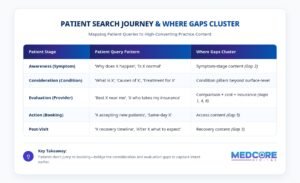
Most healthcare brands publish heavily at the consideration stage and lightly everywhere else. Rebalancing — adding symptom-stage content at the front, comparison and cost at the middle, and recovery content at the back — usually doubles total qualified traffic within two quarters because most stages are open competitive space.
How to Run a Healthcare Content Gap Analysis
Finding content gaps is a structured process, not a brainstorm. The methodology that surfaces real gaps in 2026 combines competitor data, real patient language, AI Overview audits, and your own intake data. Run it quarterly because the search landscape shifts with seasonal health trends, new treatments, and changes in how patients describe symptoms.
Step 1: Competitor Keyword Gap Analysis
Use Ahrefs’ Content Gap tool, Semrush’s Keyword Gap, or Moz’s equivalent to compare your domain against 3–5 real competitors. ‘Real competitors’ means specific local practices and hospital systems competing for your patients — not WebMD, which dominates the head terms but isn’t in your acquisition path.
Filter the gap list by:
- Keyword difficulty under 40 — realistically attainable for a healthcare practice site
- Monthly search volume of at least 50 in your geography
- Commercial or transactional intent (skip pure informational unless it slots into a cluster)
- Relevance to services you actually offer — competitor rankings on services you don’t provide are noise
Each remaining keyword gap is a candidate page. Prioritize by intent strength (transactional > evaluative > informational) and conversion potential.
Step 2: AI Overview Citation Audit
Manually check Google AI Overview presence for your top 25 commercial queries. For each, record: does an AI Overview appear, who is cited, and is your content represented? AI Overview citation gaps are different from traditional ranking gaps — AI engines often cite content that ranks on page 2 or 3 if it’s better-structured than page 1 results, so this audit surfaces opportunities competitor analysis misses.
Repeat for ChatGPT and Perplexity by running the same queries through each platform. The citation patterns differ — Perplexity favors authoritative recent content, ChatGPT pulls from a wider range, Google AI Overviews skew toward top-ranking pages. A page missing from all three is a high-priority gap.
Step 3: Patient Question Mining
This is where most analyses go wrong — they stop at tools and skip the human source. The richest keyword research input in healthcare is your own intake and front-desk team. Ask them for the top 25 questions they get every week. Capture verbatim phrasing, not paraphrased summaries — the exact words patients use are the keywords you should target.
Supplementary patient-language sources:
- Reddit (r/AskDocs, condition-specific subs) — long forum posts mirror how people phrase questions to LLMs
- Quora — question-formatted, often in patient language, sometimes with clinician answers
- Google’s ‘People Also Ask’ boxes for your seed terms — surface real adjacent queries
- AlsoAsked, AnswerThePublic, or QuestionDB — tools that aggregate question-formatted queries around any seed
- Your call recordings (with PHI redacted) — the questions patients ask before they book
- Review and feedback content — what patients said they were looking for, in their own words
Step 4: Search Intent Classification
Once you have the candidate list, classify every keyword by intent. The four-bucket model that consistently maps to healthcare content types:
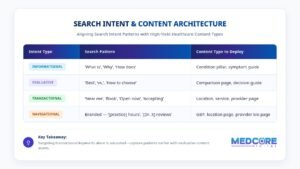
Most healthcare sites over-publish informational content (where competition with WebMD is brutal) and under-publish evaluative and transactional content (where local practices have a structural advantage). Rebalancing toward evaluative and transactional intent typically lifts conversion before it lifts traffic — and conversion is what fills the schedule.
Step 5: Map Gaps to a Content Roadmap
Convert the prioritized gap list into a publication roadmap. For each gap, capture: target keyword, intent classification, journey stage, target word count, primary source/author plan, and conversion path. Build the roadmap as a 90-day rolling calendar — quarterly cycles work better than annual ones in healthcare because seasonal patterns (flu, allergies, back-to-school physicals, open enrollment) drive predictable demand spikes.
Real Patient Queries with the Highest Gap Potential in 2026
These query patterns consistently show high demand and low local-provider coverage in 2026. Use them as starting points for your own gap analysis — most will translate to your specialty and geography with minor adjustment.
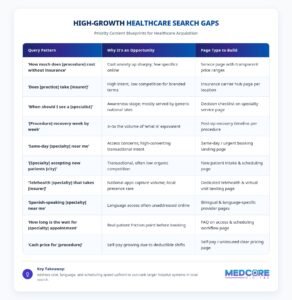
Volume on any single query may be modest. Volume across 30–50 well-built gap pages, each capturing high-intent traffic that matches your services, compounds into the largest organic acquisition channel most practices have.
Building Gap-Filling Content That Ranks and Earns AI Citations
Finding gaps is half the work. The other half is producing content that actually wins them. Princeton’s 2024 GEO research (published at KDD 2024) ranked the optimization methods that drive AI citation visibility. The top three apply directly to healthcare gap content: citing sources (+40% visibility), adding statistics (+37%), and adding expert quotations (+30%). Combine fluency with cited statistics and the lift compounds — Princeton found low-ranking sites can see up to 115% AI visibility increase with that combination.
The construction pattern that consistently wins healthcare gap content in 2026:
- Answer-first paragraph (40–60 words) that directly answers the page’s primary question. This is what AI Overviews extract.
- Question-formatted H2s and H3s matching how patients actually search (‘How long does a knee replacement last?’ beats ‘Knee Replacement Longevity’).
- Specific numbers replacing adjectives. ‘Recovery typically takes 6–8 weeks’ beats ‘recovery is typically several weeks.’ Numbers are quotable; adjectives aren’t.
- Cited authoritative sources with linked references — NIH, CDC, peer-reviewed journals, professional society guidelines. Three sources minimum on every clinical page.
- Named clinician author + medical reviewer with credentials, photo, NPI, and ‘last reviewed by Dr. [Name] on [Date].’ E-E-A-T evidence on the page.
- Schema markup appropriate to the page type — MedicalCondition + FAQPage for condition pages, MedicalProcedure for procedure pages, MedicalOrganization for the parent site.
- FAQ section (8–12 Q&A pairs) answering the next-step questions a patient would ask after reading the main content. FAQPage schema unlocks rich results.
- Single, low-friction CTA specific to the page’s intent. Generic ‘Contact us’ under-converts; ‘Book a 15-minute consult with Dr. [Name]’ converts.
| The two AI-search anti-patterns to avoid Princeton’s GEO research found that keyword stuffing actively reduces AI citation visibility by 10% — it’s the only optimization method in the study that produces a negative result. The second anti-pattern is anonymous AI-generated content. Google’s Helpful Content system suppresses unattributed medical content, and AI engines exclude it from citations. Every gap-filling page needs a real clinician byline and at least one authoritative source citation, every time. |
Common Mistakes That Make Healthcare Content Gap Analysis Fail
- Treating WebMD as a competitor. WebMD wins head terms because of domain authority, not because of content excellence. Targeting their head terms wastes effort. Target the long-tail and local variants where authority matters less than relevance.
- Optimizing for clinical terminology instead of patient language. ‘Sciatica’ has lower volume than ‘pain shooting down my leg.’ Build for both, but lead with patient language.
- Skipping the front-desk question dump. The most valuable keyword research input is the questions your team fields every day — and most teams never capture it systematically.
- Building one gigantic ‘Pricing’ page instead of insurance-specific pages. Patients search by their insurer (‘Aetna [specialty] near me’), not by ‘pricing.’ Page per major payer outperforms a single combined page.
- Ignoring AI Overview citations. A page that ranks #1 organically but isn’t cited in the AI Overview is invisible above the fold. Audit AI presence separately from rankings.
- Filling gaps with thin AI-generated content. Gap-filling at scale fails when the content is generic, anonymous, and unverified. Clinician review on every page is the floor, not a nice-to-have.
- Running gap analysis once and shelving it. Search behavior shifts with seasonal patterns and policy changes. The 2026 surge in cost-related queries (driven by ACA subsidy expiration) wasn’t visible in 2024 keyword data. Quarterly cadence is the standard.
- Optimizing for traffic volume over conversion. A 50-search-per-month page targeting ‘Aetna pediatrician Plano’ may produce more booked appointments than a 5,000-search-per-month informational article. Volume is a vanity metric in healthcare; booked appointments aren’t.
Frequently Asked Questions
What is a content gap in healthcare marketing?
A content gap in healthcare marketing is a search query — or category of queries — where patient demand exists but provider-side content doesn’t. The query goes to WebMD, Reddit, a national directory, or an AI-generated answer that doesn’t include local providers. Filling content gaps means publishing structured, clinician-attributed answers to those queries so AI engines and search engines start citing your practice instead of generic national sources.
How do I do keyword research for a healthcare website?
Combine four inputs: (1) competitor keyword gap tools (Ahrefs, Semrush, Moz) to find terms competitors rank for that you don’t; (2) real patient language captured from your front desk’s top 25 weekly questions; (3) AI Overview audits across your top 25 commercial queries to find AI-citation gaps; and (4) Google’s ‘People Also Ask,’ Reddit threads, and Quora to surface question-formatted variants. Filter by keyword difficulty under 40, minimum 50 monthly searches in your geography, and intent that matches your services.
What do patients actually search for in healthcare?
Patients search in plain language, often phrased as questions, and increasingly anchored in cost and access. The four highest-volume patterns: (1) symptoms before diagnoses (‘sharp pain in lower right abdomen’ beats ‘appendicitis symptoms’); (2) full questions (‘how long does a knee replacement last’); (3) cost and insurance combinations (‘does [practice] take Aetna,’ ‘how much without insurance’); and (4) access queries (‘accepting new patients,’ ‘same-day,’ ‘wait time’). Cost-related searches surged in 2026 — search interest in ‘cheap health insurance’ rose over 160% year-over-year — driven by ACA subsidy expiration and 58% Marketplace premium increases.
How is patient search intent in healthcare different from other industries?
Healthcare patient search intent is uniquely high-stakes, low-information, and non-linear. Patients often search for a symptom, then a diagnosis, then a specialist, then an insurance check, then a comparison, then a booking — across hours, days, or weeks. Trust signals (clinician credentials, cited sources, reviews) carry far more weight than in most categories because Google classifies healthcare as YMYL (Your Money or Your Life) content. Practical implication: thin or unattributed content rarely ranks for healthcare queries even when it does in other verticals.
How long does it take to fill a healthcare content gap and see results?
New content typically takes 60–120 days to reach meaningful organic position for healthcare queries with keyword difficulty under 40, assuming the page is well-structured, clinician-authored, schema-marked, and internally linked. AI Overview citations can appear faster — within 2–4 weeks — for pages with strong answer-first paragraphs and authoritative source citations. Highly competitive queries in major metros take 6–9 months. The 30–50-page rule applies: organic compound returns kick in once you have meaningful gap coverage across a service line, not from a single page.
Should I focus on high-volume keywords or long-tail keywords for healthcare SEO?
Long-tail. High-volume head terms (‘cardiologist,’ ‘dentist’) are dominated by directories and national sites with domain authority your local practice can’t match. Long-tail combinations (‘cardiologist who takes Aetna in Plano,’ ‘Spanish-speaking pediatrician West Plano’) have lower volume but dramatically higher intent and conversion. A practice ranking for 50 long-tail terms typically generates more booked appointments than one ranking for a single high-volume head term.
How often should healthcare brands re-run their content gap analysis?
Quarterly. Patient search behavior shifts with seasonal health trends (flu, allergies, back-to-school physicals), policy changes (ACA subsidy expiration drove the 2026 cost-search surge), new treatments entering the market, and how patients describe symptoms online (LLM-influenced phrasing patterns are evolving fast). Quarterly cycles surface emerging gaps before competitors notice them. Annual cycles miss the seasonal opportunities that drive predictable demand spikes.
The Bottom Line
Healthcare content marketing in 2026 is not a publishing problem. It’s a translation problem. Patients ask questions in their language, at the moment they need an answer, in the format an AI engine can extract. Most provider sites publish in clinical language, at the diagnosis stage, in formats designed for an outdated SERP. The brands closing the gap — symptom-language pages, cost and insurance content, recovery timelines, comparison guides, access pages, condition + insurance + location combinations, telehealth content — are pulling ahead while their competitors keep publishing the same condition pillars they’ve published for a decade.
The work isn’t glamorous. Pull the front-desk question list. Run a competitor gap tool. Audit AI Overview citations for your top 25 queries. Classify by intent. Build the 30–50-page roadmap. Ship pages with clinician bylines, cited sources, and schema. Re-run the audit every quarter. Adjust for the season, the policy change, and the algorithm refresh.
Brands that ship under this discipline outrank competitors with twice their budget — because in healthcare, gap coverage compounds visibility, AI citations, and booked appointments all at once.
If you don’t know which content gaps are open in your service area — or which of your existing pages are losing AI Overview citations to national sites — that’s where to start. Medcore Digital runs healthcare content gap audits and builds roadmaps mapped to patient intent, AI citation eligibility, and booked-appointment potential. Get in touch at medcoredigital.com.