
Why Are AI-Generated Reviews a Bigger Threat in Healthcare?
Healthcare falls into the “Your Money or Your Life” category, so patients weigh other patients’ experiences heavily before booking, and search engines hold medical content to a higher trust standard. AI-written reviews are cheap to produce in volume and varied enough to slip past basic spam filters, which makes them harder to catch than older fake reviews.
Older fake reviews usually came from click farms or paid services and tended to recycle the same few sentences. AI changes the economics. Someone with a grudge or a competing practice can produce a month of believable reviews for a few dollars, spread them across fresh accounts, and vary the tone so no two read alike. The damage also reaches past the review sites themselves. Deepfake videos impersonating physicians have already turned up in health scams on social media, and synthetic reviews can feed into the summaries AI search tools write about a practice. Medical reputation management now has to account for how a practice is described in AI-generated answers as well as for its star average.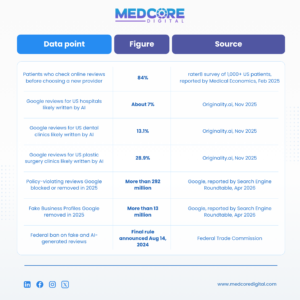
How Can a Medical Practice Spot AI-Generated Fake Reviews?
Look for reviews with no concrete detail, phrasing that repeats across several reviews, extreme praise or anger with no context, and reviewer accounts with no history that post in tight clusters. One sign alone proves very little. Three or four together justify a closer look and a report to the platform.
Warning Signs in the Review Text
- No mention of a provider’s name, a procedure, the front desk, parking, or how long the wait was.
- Stock enthusiasm such as “game-changer,” “life-changing,” or “perfect in every way,” with nothing to back it up.
- Openings or sentence structures that repeat across reviews posted for the same practice.
- An oddly formal, polished tone, heavy use of long dashes, and stock phrases like “the first thing that struck me.”
- Negative reviews describing a generic bad experience without a single detail a real patient would remember.
Warning Signs in the Reviewer Profile
- A new account with no other reviews, or a history of reviews scattered across unrelated cities.
- Several reviews arriving within the same day or week after a long quiet stretch.
- Reviewers who post about the practice and a nearby competitor in the same pattern.
What the Platforms Already Catch
Google says Gemini now helps its systems block policy-violating content before it goes live, and the company blocked or removed more than 292 million policy-violating reviews in 2025. Healthgrades, Vitals, and Zocdoc run their own moderation, and Zocdoc collects its own reviews only from patients who booked through Zocdoc and whose provider marked the appointment as attended, with a person moderating each review before it goes live. Platform filters still miss some fakes, which is why practice-level monitoring matters.How Do You Report a Fake Review on Google, Healthgrades, Zocdoc, WebMD, Vitals and Yelp?
Every major platform lets a practice report a review, but none lets a practice delete one. Reports are judged against each platform’s own content rules, so a review has to break a specific policy, such as fake engagement, a conflict of interest, or private information. Disliking the rating is not enough.
| Platform | Where to report | What to know |
|---|---|---|
| Business Profile, then Reviews, then “Flag as inappropriate” (FTC guide) | Only reviews that break Google’s content policy are removed. Reports can be tracked in Google’s Reviews Management Tool. | |
| Healthgrades | The flag button on the review, or the Healthgrades contact form | Provider listings are built from the federal NPI registry, so a profile exists even if the practice never claimed it. |
| Zocdoc | Zocdoc’s contact page, with specific evidence (Zocdoc) | Only patients who booked and attended can review. A person moderates each review, and removal needs a guideline violation, not just suspicion. |
| WebMD | WebMD customer support | WebMD states that providers cannot remove or modify reviews themselves (WebMD). |
| Vitals | The “Report Abuse” button on the review, or the Vitals support request form | There is no delete option, so the report must cite a guideline. |
| Yelp | biz.yelp.com, Reviews page, three dots, “Report Review” (FTC guide) | Yelp’s recommendation software hides some reviews automatically, and owners cannot override it. |
How to Report a Fake Healthgrades Review
Open the review on the provider’s Healthgrades profile and use the flag option on the review. Choose the reason that fits, such as spam, private information or wrong provider, and add a short factual note explaining what looks fake. If the flag does not resolve it, Healthgrades also takes reports through its contact form and review-related email addresses listed on its site. Healthgrades builds provider profiles from public records, so a practice may find a profile it never created. Claiming the profile lets the practice manage its details and respond to patient feedback, and any reply should follow the HIPAA rules covered below.How to Report a Fake WebMD Review
WebMD states that providers cannot remove or modify reviews on their own. The route is to contact WebMD support, quote the specific review guideline it breaks, and attach evidence such as matching phrases across reviews or a reviewer who clearly was not a patient. Reports are handled by WebMD’s moderators, so removal is a decision the practice cannot force.What Every Report Should Include
- The exact review text and the date it was posted.
- The specific policy it breaks, named in the platform’s own words where possible.
- The pattern: matching phrases, several reviews landing within days, or reviewer accounts with no history.
- A statement of fact only. Anything drawn from a patient record stays inside the practice and never goes into a report.
What to Do If the Platform Says No
A rejected report does not end the work. Check whether the review truly breaks a written policy, and if so submit a second report with clearer evidence. If the review is simply negative, a calm public reply and a steady flow of genuine reviews do more than repeated appeals. A review that makes a false statement of fact may call for advice from healthcare counsel, since legal routes differ by state.How Can a Practice Protect Its Online Reputation From Fake Reviews?
Protecting a practice from fake reviews comes down to a few steady habits: watch every profile closely, report suspicious reviews with evidence, reply to every review in HIPAA-safe language, keep genuine patient feedback coming in, and give patients and AI tools more to judge the practice by than a star rating.1. Monitor Every Profile, With AI Tools Doing the First Pass
Set alerts for new reviews on Google, Healthgrades, Vitals, Yelp, and Zocdoc, along with any social pages where patients leave comments. Sentiment and anomaly detection tools can scan these public reviews, flag sudden spikes, and track how sentiment moves over time without touching protected health information. A person should still do a manual pass every week, because clusters are far easier to get removed when they are reported within days.2. Reply Publicly Without Confirming Anyone Is a Patient
HIPAA applies to review replies. A response that confirms someone was treated, even indirectly, can count as a disclosure of protected health information, and the HHS Office for Civil Rights has penalized practices for exactly this. In December 2022, OCR announced that New Vision Dental in California paid $23,000 after disclosing patients’ protected health information while replying to online reviews (HHS announcement). Keep replies short and neutral, and use the same tone whether the review looks real or fake:Thank you for sharing this. (Practice Name) takes all feedback seriously, and our office manager would like to speak with you directly. Please call (phone number) at your convenience.Arguing in public that a review is fake rarely helps. Readers cannot verify the claim, and the reply often stays visible long after the platform takes the review down.
3. Use AI Review Response Tools Carefully
Many review platforms now draft replies with AI, which saves time for a busy front desk. For a medical practice, the risk is that a drafted reply echoes a detail from the review or from a connected appointment record, which can confirm someone is a patient. A safe setup has four parts:- Neutral templates first. The tool drafts from approved, no-detail language, never from patient records.
- A person approves every reply before it posts, with no auto-publish for medical practices.
- A business associate agreement (BAA) if the tool connects to any system that holds protected health information. Ask the vendor directly, since a privacy page is not a BAA.
- A clear policy for staff that nothing from a chart, schedule or intake form is ever pasted into a general-purpose AI tool.
4. Ask Every Patient for Feedback, the Compliant Way
A steady stream of real reviews is the strongest defense against a burst of fake ones. When fresh, detailed reviews arrive every month, a sudden cluster of vague ones stands out to readers and to platform filters. Review solicitation works when it follows a few rules:- Ask everyone, not just happy patients. Asking only satisfied patients, often called review gating, breaks Google’s policies.
- Offer no incentives. Rewards tied to reviews are prohibited on Google and restricted under the FTC rule.
- Send the request through a HIPAA-compliant text or email system, with wording that does not mention the visit’s reason or treatment.
- Make it easy. One direct link to the profile, sent soon after the visit, outperforms a poster at the front desk.
- Do not push Yelp. Yelp discourages businesses from asking for reviews and may filter reviews that look solicited, so focus requests on Google and the healthcare directories.
- Never ask a patient to change or remove a review. Zocdoc, for one, prohibits providers from retaliating against patients who leave critical reviews.
5. Build Proof Beyond Review Sites
Clinician-bylined articles, patient stories shared with written consent, provider videos, and accurate directory listings give patients more to go on than a star average. Structured data helps too: schema markup for doctors tells search engines who the practice is and what it offers. AI search tools draw on these sources when they describe a practice, so a practice with strong first-party content is less exposed when a handful of fake ratings slip through. The ultimate guide to SEO in 2026 covers how this fits into the wider search picture. Medcore Digital’s healthcare reputation management services cover profile audits, monitoring setup, and HIPAA-safe response workflows for medical practices.What Does the Law Say About AI-Generated Reviews?
The FTC’s final rule on consumer reviews, announced August 14, 2024, bans fake reviews and testimonials, including those generated by AI, and lets the agency seek civil penalties against knowing violators. It covers businesses that write, buy, or knowingly share fake reviews, and it also bars suppressing negative reviews through threats or intimidation. For practices, the rule works in both directions. A practice that buys reviews, lets staff post undisclosed reviews, or uses AI to write testimonials is exposed. A practice targeted by fake reviews has a clearer basis for reporting them. State law adds more. California’s AB 489, in effect since January 1, 2026, bars AI systems from using titles such as “Doctor” or “M.D.” or otherwise implying that a licensed provider is involved, and in 2025 Arkansas, Montana, Pennsylvania, and Utah passed laws on AI-generated digital replicas of real people used for commercial purposes. Rules differ from state to state. This section is general information, and practices should confirm specifics with healthcare counsel.Why Authentic Patient Feedback Holds Up Over Time
Practices that consistently collect real, detailed patient feedback end up with profiles that are harder to manipulate and more useful to the people reading them. As platforms improve detection and the FTC rule sees enforcement, a long record of genuine reviews and careful replies is a trust signal that fake reviews struggle to copy. The same technology that writes fake reviews is also used to catch them, and neither side stays ahead for long. What holds up is the steady work: real patients describing real visits, replies that respect privacy, and someone who checks the profiles every week. For practices that want that process set up and monitored, book a discovery call with Medcore Digital.Frequently Asked Questions
What Are AI-Generated Fake Reviews in Healthcare?
They are reviews written by AI language models and posted as if they came from real patients. They can inflate a practice’s rating with invented praise or damage it with coordinated negative reviews. Because the wording changes from one review to the next, they are harder to catch than older copy-and-paste review spam.
How Can a Medical Practice Tell if a Review Was Written by AI?
Look for missing specifics such as provider names or procedures, generic praise or anger, phrasing that repeats across reviews, and reviewer accounts with no history posting in clusters. AI detectors can help sort large volumes, but they produce false positives, so a person should review the full pattern before reporting it.
How Do You Report a Fake Healthgrades Review?
Open the review on the provider’s Healthgrades profile, use the flag option, choose the closest reason, and add a short factual note. If the flag does not resolve it, Healthgrades also accepts reports through its contact form. Removal is not guaranteed, because the platform judges each report against its own guidelines.
Can a Practice Get a Fake Review Removed From Google?
A practice can flag the review from its Google Business Profile and cite the relevant policy, such as fake engagement. Documented evidence of a pattern strengthens the report. Google reviews each report against its policies, and removal is not guaranteed, so the practice should keep monitoring and reply publicly in neutral, HIPAA-safe language in the meantime.
Can a Practice Remove a Fake WebMD Review?
WebMD states that providers cannot remove or modify reviews on their own. A practice can contact WebMD support, cite the specific review guideline that was broken, and attach evidence such as repeated phrasing or a reviewer who clearly was not a patient. WebMD’s moderators make the final decision.
Is It Illegal to Buy or Post AI-Generated Reviews?
Under the FTC rule announced in August 2024, businesses may not create, buy, or knowingly share fake reviews, including AI-generated ones, and the FTC can seek civil penalties against knowing violators. Google, Yelp, and healthcare directories also prohibit fake reviews in their own policies. Practices should confirm specifics with healthcare counsel.
How Should a Practice Respond to a Suspected Fake Review Without Violating HIPAA?
Reply briefly and neutrally, without confirming that the reviewer is or was a patient and without mentioning any visit, treatment, or personal detail. Invite the reviewer to contact the office directly, and report the review to the platform separately. Avoid calling a review fake in public, since readers have no way to verify that claim.
Is It Safe to Use AI Tools to Reply to Patient Reviews?
It can be, with limits. The tool should draft from approved, no-detail templates, a person should approve every reply, and nothing from a chart or schedule should be pasted into it. If the tool connects to systems holding patient information, the practice should ask the vendor for a business associate agreement.
How Can a Practice Ask for Reviews Without Breaking the Rules?
Ask every patient, not just satisfied ones, since review gating breaks Google’s policies. Offer no rewards, send requests through a HIPAA-compliant system, and never ask a patient to edit or remove a review. Yelp discourages solicited reviews, so requests work best on Google and healthcare directories.
How Does Medcore Digital Help With Healthcare Reputation Management?
Medcore Digital audits a practice’s review profiles across Google and healthcare directories, sets up monitoring for unusual review activity, builds HIPAA-safe response workflows, and designs a compliant process for asking every patient for feedback. Medcore Digital does not guarantee review removals or rating outcomes, because the platforms make those decisions.