
A patient with a new rash rarely types three words into a search bar anymore. She photographs the spot with her phone, asks out loud what it could be, and then asks which dermatologist nearby has an opening this week. Each step produces an answer from an AI system, and a practice’s website may never earn a click along the way.
That behavior is now mainstream. A March 2026 KFF poll found that 32% of U.S. adults used AI chatbots for health information in the past year, and Google reported at I/O 2026 that AI Overviews have more than 2.5 billion monthly users. Voice search SEO for healthcare and multimodal SEO now decide whether a practice gets named in those answers.
This guide covers the parts of AI search optimization that matter most for SEO for healthcare providers in 2026: how patients search by voice and image, how Answer Engine Optimization works, which structured data still counts after Google’s May 2026 changes, and how to keep every piece of content HIPAA-compliant.
How Are Patients Searching for Care in 2026?
Patients now search by speaking full questions, pointing a phone camera at a problem, and asking AI assistants for recommendations. Longer, question-style searches are the most likely to trigger an AI-generated answer, so the conversational way people describe symptoms and care is the format Google and other AI engines now answer first.
Search Behavior Shaping Healthcare Discovery in 2026
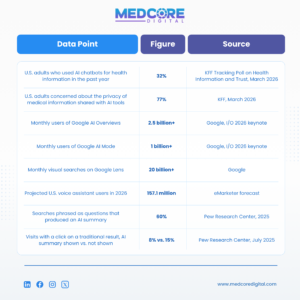
Two of those numbers pull in opposite directions. Patients are turning to AI for health questions in large numbers, yet 77% worry about what happens to medical information they share with AI tools. A practice that earns visibility in AI answers and is visibly careful with privacy speaks to both concerns at once.
What Does Voice Search Change for Medical Practices?
Voice search turns short keywords into full sentences. Instead of typing “urgent care Miami,” a patient asks, “Which urgent care near me is open right now and takes Aetna?” Pages that answer complete questions directly, with accurate hours, locations, and insurance details, give voice assistants and AI engines an answer they can read back with confidence.
These conversational healthcare search queries carry more intent than typed keywords. They often name a symptom, a time of day, an insurance plan, or a neighborhood, and the person asking expects one answer. Pew Research Center found that 60% of Google searches phrased as questions produced an AI summary, compared with 8% of one- or two-word searches. The more a search sounds like speech, the more likely an AI system is to answer it before any link gets clicked.
Google has also merged voice and camera into a single search. Search Live in AI Mode rolled out across the U.S. in September 2025 and has since expanded to the countries where AI Mode is available. It lets a person talk to Search while sharing a live camera view, so a patient can point a phone at a knee brace or a prescription label and ask a follow-up question out loud.
How Should a Practice Write for Spoken Questions?
Voice search optimization for medical practices starts with headings written as the questions patients actually ask, followed by a direct answer in the first one or two sentences. Plain language matters as much as accuracy. A patient listening to an answer cannot scroll back, so short sentences and everyday terms work better than clinical shorthand.
- Turn the questions the front desk hears every week into page headings, for example “Does the clinic accept Medicare Advantage?”
- Put the answer first and the explanation second, keeping the core answer to two sentences.
- Keep hours, holiday closures, and phone numbers identical on the website and every listing, because spoken answers about a practice pull from those details.
- Write symptom and treatment content at a level a patient can follow when it is read aloud, and have a licensed clinician review it before it goes live.
What Is Multimodal Search SEO in Healthcare?
Multimodal search SEO prepares a practice’s content to be found when a single search mixes text, voice, images, and video. Google Lens alone handles more than 20 billion visual searches a month. When a patient’s question starts with a photo or ends with a video, every format on the page needs labels that search engines and AI systems can read.
For medical SEO, a procedure page now includes the written explanation, the diagram, the short clinician video, and the transcript beneath it. AI systems can pull from any of those pieces when they assemble an answer, so each one needs to make sense on its own.
How Should Medical Images and Videos Be Prepared for Search?
Image SEO for healthcare relies on descriptive file names, alt text that explains what an image shows, and captions placed beside it. Video SEO for medical practices depends on complete, accurate transcripts and VideoObject markup. Together they make visual content readable to search engines and accessible to patients who use screen readers.
- Alt text: describe the image plainly, for example “Diagram of a torn meniscus inside the knee joint.”
- File names: rename IMG_4031.jpg to knee-meniscus-tear-diagram.jpg before uploading.
- Transcripts: publish the full transcript on the page and include it in VideoObject markup through the transcript property.
- Captions and chapters: upload accurate captions and add timestamps for each question a video answers.
- Patient images: before-and-after photos and patient videos need the patient’s written HIPAA authorization before they appear online.
- Interactive tools: an insurance lookup or appointment finder gives patients a reason to act on the page, while symptom checkers carry clinical risk and need clinical and legal review first.
Medcore Digital runs multimodal content audits that map each page’s images, videos, and transcripts against the questions patients ask most, then fixes the gaps in order of patient demand.
How Does Answer Engine Optimization Make a Practice the Direct Answer?
Answer Engine Optimization (AEO) structures content so AI engines can lift a clear, accurate answer straight from a practice’s page. Pew Research Center found that only 1% of visits to Google results pages with an AI summary led to a click on a cited source, so being the practice an AI names in its answer carries real weight.
AEO works alongside Generative Engine Optimization (GEO), which focuses on earning citations in tools such as ChatGPT, Perplexity, Gemini, and Google AI Mode, and both reward the same writing habits. Take the question “Can telemedicine treat anxiety?” A strong page answers it in the opening paragraph: licensed clinicians commonly assess and treat anxiety through telehealth visits, and care plans can include therapy, medication management, or both. The rest of the page explains who is a good fit, when in-person care is the better choice, and what a first virtual visit looks like.
Strong AI search optimization for healthcare content includes:
- Question clusters that move from broad (“What is telehealth?”) to specific (“How does virtual therapy work for panic attacks?”)
- A 40 to 60 word answer directly under each question heading
- A named clinician reviewer with credentials and a visible “last reviewed” date
- Outbound citations to authoritative sources such as the CDC, NIH, and peer-reviewed journals
- Outcome data shared only in aggregate, de-identified form
This structure lines up with the experience, expertise, authoritativeness, and trust (E-E-A-T) signals Google weighs heavily on health topics.
Which Healthcare Structured Data Matters for Voice and AI Search?
Healthcare structured data is code that tells search engines and AI systems exactly what a page describes: the clinic, its location and hours, its physicians, and the services it offers. Clean medical schema markup gives voice assistants and AI engines verified facts to work from, so they do not have to infer details from page text.
The schema types that matter most for a medical practice:
- MedicalClinic, Dentist, or the closest Schema.org subtype: name, address, phone, geo coordinates, openingHoursSpecification with holiday hours, medicalSpecialty, and areaServed.
- IndividualPhysician: one per provider, with medicalSpecialty, usNPI for the provider’s National Provider Identifier, and practicesAt linking the physician to each clinic. Schema.org added these in version 24.0 in January 2024.
- MedicalProcedure or MedicalTherapy: one per service page.
- VideoObject: one per clinician video, with name, description, uploadDate, thumbnailUrl, and transcript.
- FAQPage: for question-and-answer sections on service and location pages.
What Happened to FAQ Rich Results in 2026?
Google stopped showing FAQ rich results for all websites in May 2026, including the health and government sites that had kept them after the 2023 restriction. Google also retired the FAQ rich result report and Rich Results Test support in June 2026. FAQPage markup itself remains valid Schema.org code that machines can still read.
What Are the Structured Data Best Practices for Medical Practices?
Define service areas explicitly to support geo-targeted healthcare SEO, list exact opening hours including holidays, and use the most specific schema type and specialty available. Validate every change with Google’s Rich Results Test and the Schema Markup Validator, then watch Search Console for new warnings after each site update.
- Keep markup identical to what patients can see on the page. Google’s guidelines require structured data to reflect visible content.
- Keep patient information out of structured data entirely. Schema should describe the practice and its providers only.
How Does Geo-Targeted Healthcare SEO Win Local Voice Searches?
Geo-targeted healthcare SEO connects a practice to the places patients search from. When someone asks for a “pediatrician open Saturday near me,” voice assistants lean on verified business listings, accurate hours, and location-specific pages. A practice with consistent details across all of those sources gives an assistant one clear answer to read aloud.
Local SEO for medical practices starts with a verified profile and builds outward:
- Google Business Profile optimization: choose the most precise primary category, keep hours and holiday hours current, add an appointment link, and describe each service in plain language.
- Apple Business Connect and Bing Places: claim both so Apple Maps and Bing show the same details patients see on Google.
- Location pages: build one page per clinic with full NAP, an embedded map, parking and transit notes, and the providers who practice there.
- NAP consistency: match the name, address, and phone number character for character across the website, listings, and healthcare directories such as Healthgrades and Zocdoc.
- Patient reviews: ask every patient for feedback the same way. Google’s policies prohibit offering incentives for reviews, and public replies should never confirm that a reviewer is a patient.
- Hyper-local phrasing: use natural phrases such as “emergency dental care in Coral Gables,” and list the neighborhoods and ZIP codes each location serves in page copy and areaServed markup.
How Can Voice and Video Content Stay HIPAA-Compliant?
HIPAA-compliant SEO means protected health information (PHI) never appears in public content, transcripts, image files, or tracking data tied to identifiable patients. Every case study, FAQ, and video should be de-identified or backed by written patient authorization, and any vendor that handles PHI needs a signed business associate agreement.
- Review every transcript and caption before publishing for names, dates, and details that could identify a patient.
- Keep telehealth recordings inside HIPAA-compliant clinical systems, since they are part of the medical record and have no place in marketing content.
- Treat on-site chatbots and voice tools that collect symptoms or appointment details as PHI handlers, with a business associate agreement in place.
- Audit analytics and advertising pixels, especially on patient portals and booking flows.
The HHS HIPAA for Professionals guidance is the primary reference for the full compliance framework.
| COMPLIANCE NOTE In June 2024, a federal court in Texas vacated the part of HHS guidance on online tracking technologies that covered public, unauthenticated web pages, and HHS later dropped its appeal. Guidance for authenticated pages such as patient portals was not vacated, and state privacy laws may still apply. Review tracking tools with privacy counsel and see the HHS guidance on online tracking technologies. |
What Does a Practical Multimodal Content Roadmap Look Like?
A workable roadmap starts with real patient questions and ends with measurement. The five steps below give a practice a repeatable cycle for voice search optimization, image readiness, and AI visibility, with a review every quarter so content stays accurate as search features and clinical guidance change.
- Audit the top 50 patient questions across typed search, voice queries, front-desk calls, and patient portal messages.
- Match each question to the format that answers it best: written pages for depth, short videos for demonstrations, and labeled images for anatomy or recovery steps.
- Build with accessibility in mind, including alt text, transcripts, captions, readable contrast, and fast mobile pages.
- Track performance in Google Search Console with the Web: multimodal filter and the Generative AI performance report.
- Refresh content every quarter, updating the “last reviewed” date and clinician sign-off each time.
What Can Search Console Show About Voice and Image Search?
Search Console does not report voice searches separately. Clicks and impressions from AI Overviews and AI Mode are counted inside the Web search type. Since September 24, 2026, a Web: multimodal filter shows traffic from searches that used an image, such as Google Lens and Circle to Search, without query data.
The Generative AI performance report shows how often a site’s pages appear in AI Overviews and AI Mode, but it counts impressions only, with no clicks or queries. Pairing it with call tracking and booking data connects AI visibility to patient acquisition.
Frequently Asked Questions
What is multimodal SEO for healthcare?
Multimodal SEO for healthcare prepares a medical practice’s text, images, video, and voice-ready answers so search engines and AI assistants can use any of them in a response. It combines descriptive alt text, full video transcripts, structured data, and question-based page copy, so the practice can appear whether a patient searches by voice or with a photo.
How is voice search SEO different from traditional medical SEO?
Traditional medical SEO targets short typed keywords and ranking positions. Voice search SEO targets full spoken questions and aims for the single answer an assistant reads aloud. That shifts the work toward question-based headings, direct two-sentence answers, and listings with correct hours, locations, and phone numbers, since spoken local answers depend on those details.
Is FAQ schema still worth adding to a medical website?
Yes, with adjusted expectations. Google stopped displaying FAQ rich results for every site in May 2026, so the markup no longer changes how a listing looks. It remains valid Schema.org code and gives search engines and AI systems a labeled version of each question and answer, which keeps it useful on service and location pages.
Which schema types should a medical practice use for AI search optimization?
Most practices need MedicalClinic or the closest subtype for each location, IndividualPhysician for each provider with the NPI number in the usNPI property, MedicalProcedure or MedicalTherapy for service pages, VideoObject with transcripts for clinician videos, and FAQPage for question sections. Every property should match what patients can see on the page.
Can a practice see voice search traffic in Google Search Console?
Not as a separate report. Search Console counts AI Overviews and AI Mode activity inside the Web search type and does not label voice queries. A Web: multimodal filter added in September 2026 shows image-led searches such as Google Lens, and the Generative AI performance report shows AI feature impressions, though not clicks.
How does Medcore Digital help practices with voice and multimodal search?
Medcore Digital, a healthcare marketing agency focused on SEO, AEO, and GEO, audits a practice’s top patient questions, rebuilds key pages with question-based copy and healthcare structured data, prepares images and videos for multimodal search, and reviews every asset for HIPAA risk. A practice can start with a complimentary voice readiness assessment.