
A five-star review that calls a visit “life-changing” without naming a doctor, a procedure, or a wait time used to be easy to dismiss. Language models can now write hundreds of them in an afternoon, each worded a little differently, and they are landing on the same profiles patients use to pick a dentist or a surgeon.
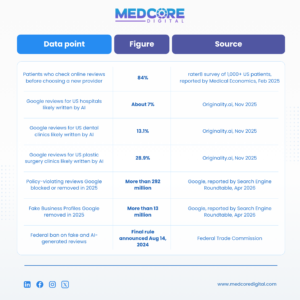
An Originality.ai analysis of Google reviews, published in November 2025, estimated that about 7% of reviews for US hospitals, 13.1% for US dental clinics, and 28.9% for US plastic surgery clinics were likely written by AI. Those numbers come from a detection tool applied to a snapshot of reviews longer than 50 words, so they are estimates. Still, the direction is hard to ignore.
For healthcare reputation management, and for online reputation management for doctors in particular, this changes the work. Fake praise props up a competitor’s rating. A coordinated wave of negative reviews can push a practice down the local pack. And patients lean on those reviews: 84% check online reviews before choosing a new provider, according to a 2025 rater8 survey of more than 1,000 US patients. When some of that feedback is manufactured, patients have a harder time telling which reviews to trust.
Why Are AI-Generated Reviews a Bigger Threat in Healthcare?
Healthcare falls into the “Your Money or Your Life” category, so patients weigh other patients’ experiences heavily before booking, and search engines hold medical content to a higher trust standard. AI-written reviews are cheap to produce in volume and varied enough to slip past basic spam filters, which makes them harder to catch than older fake reviews.
Older fake reviews usually came from click farms or paid services and tended to recycle the same few sentences. AI changes the economics. Someone with a grudge or a competing practice can produce a month of believable reviews for a few dollars, spread them across fresh accounts, and vary the tone so no two read alike.
The damage also reaches past the review sites themselves. Deepfake videos impersonating physicians have already turned up in health scams on social media, and synthetic reviews can feed into the summaries AI search tools write about a practice. Medical reputation management now has to account for how a practice is described in AI-generated answers as well as for its star average.
How Can a Medical Practice Spot AI-Generated Fake Reviews?
Look for reviews with no concrete detail, phrasing that repeats across several reviews, extreme praise or anger with no context, and reviewer accounts with no history that post in tight clusters. One sign alone proves very little. Three or four together justify a closer look and a report to the platform.
Warning Signs in the Review Text
- No mention of a provider’s name, a procedure, the front desk, parking, or how long the wait was.
- Stock enthusiasm such as “game-changer,” “life-changing,” or “perfect in every way,” with nothing to back it up.
- Openings or sentence structures that repeat across reviews posted for the same practice.
- An oddly formal, polished tone, heavy use of long dashes, and stock phrases like “the first thing that struck me.”
- Negative reviews describing a generic bad experience without a single detail a real patient would remember.
Warning Signs in the Reviewer Profile
- A new account with no other reviews, or a history of reviews scattered across unrelated cities.
- Several reviews arriving within the same day or week after a long quiet stretch.
- Reviewers who post about the practice and a nearby competitor in the same pattern.
AI detection tools can help sort through a large backlog, but their scores should be treated as one input among several. They flag some real reviews as AI, especially short or formulaic ones written by genuine patients.
What the Platforms Already Catch
Google says Gemini now helps its systems block policy-violating content before it goes live, and the company blocked or removed more than 292 million policy-violating reviews in 2025. Healthgrades, Vitals, and Zocdoc run their own moderation, and Zocdoc collects its own reviews only from patients who booked through Zocdoc and whose provider marked the appointment as attended, with a person moderating each review before it goes live. Platform filters still miss some fakes, which is why practice-level monitoring matters.
How Can a Practice Protect Its Online Reputation From Fake Reviews?
Protecting a practice from fake reviews comes down to a few steady habits: watch every profile closely, report suspicious reviews with evidence, reply to every review in HIPAA-safe language, keep genuine patient feedback coming in, and give patients and AI tools more to judge the practice by than a star rating.
1. Monitor Every Profile, With AI Tools Doing the First Pass
Set alerts for new reviews on Google, Healthgrades, Vitals, Yelp, and Zocdoc, along with any social pages where patients leave comments. Sentiment and anomaly detection tools can scan these public reviews, flag sudden spikes, and track how sentiment moves over time without touching protected health information. A person should still do a manual pass every week, because clusters are far easier to get removed when they are reported within days.
2. Report Suspected Fakes With Evidence
Flag the review through the platform’s reporting tool and cite the specific policy it breaks, such as fake engagement or conflict of interest on Google. Document the pattern: posting dates, matching phrases, and reviewer histories. Staff can check internally whether a reviewer matches any appointment record, but that check stays inside the practice. Nothing from a patient record belongs in the report or in a public reply.
3. Reply Publicly Without Confirming Anyone Is a Patient
HIPAA applies to review replies. A response that confirms someone was treated, even indirectly, can count as a disclosure of protected health information, and the HHS Office for Civil Rights has penalized practices for exactly this. In December 2022, OCR announced that New Vision Dental in California paid $23,000 after disclosing patients’ protected health information while replying to online reviews (HHS announcement).
Keep replies short and neutral, and use the same tone whether the review looks real or fake:
“Thank you for sharing this. (Practice Name) takes all feedback seriously, and our office manager would like to speak with you directly. Please call (phone number) at your convenience.”
Arguing in public that a review is fake rarely helps. Readers cannot verify the claim, and the reply often stays visible long after the platform takes the review down.
4. Keep Genuine Reviews Coming In
A steady stream of real reviews is the strongest defense against a burst of fake ones. Ask every patient for feedback after the visit through a HIPAA-compliant text or email, including patients whose visit did not go perfectly. Asking only happy patients, often called review gating, breaks Google’s policies, and incentives tied to reviews are prohibited on Google and restricted under the FTC rule. When fresh, detailed reviews arrive every month, a sudden cluster of vague ones stands out to readers and to platform filters.
5. Build Proof Beyond Review Sites
Clinician-bylined articles, patient stories shared with written consent, provider videos, and accurate directory listings give patients more to go on than a star average. AI search tools draw on these sources too when they describe a practice, so a practice with strong first-party content is less exposed when a handful of fake ratings slip through.
Medcore Digital’s healthcare reputation management services cover profile audits, monitoring setup, and HIPAA-safe response workflows for medical practices.
What Does the Law Say About AI-Generated Reviews?
The FTC’s final rule on consumer reviews, announced August 14, 2024, bans fake reviews and testimonials, including those generated by AI, and lets the agency seek civil penalties against knowing violators. It covers businesses that write, buy, or knowingly share fake reviews, and it also bars suppressing negative reviews through threats or intimidation.
For practices, the rule works in both directions. A practice that buys reviews, lets staff post undisclosed reviews, or uses AI to write testimonials is exposed. A practice targeted by fake reviews has a clearer basis for reporting them. State law adds more. California’s AB 489, in effect since January 1, 2026, bars AI systems from using titles such as “Doctor” or “M.D.” or otherwise implying that a licensed provider is involved, and in 2025 Arkansas, Montana, Pennsylvania, and Utah passed laws on AI-generated digital replicas of real people used for commercial purposes. Rules differ from state to state. This section is general information, and practices should confirm specifics with healthcare counsel.
Why Authentic Patient Feedback Holds Up Over Time
Practices that consistently collect real, detailed patient feedback end up with profiles that are harder to manipulate and more useful to the people reading them. As platforms improve detection and the FTC rule sees enforcement, a long record of genuine reviews and careful replies is a trust signal that fake reviews struggle to copy.
There is something uncomfortable about the whole situation. The same technology that writes fake reviews is also used to catch them, and neither side stays ahead for long. What holds up is the unglamorous, steady work: real patients describing real visits, replies that respect privacy, and someone who checks the profiles every week.
Frequently Asked Questions
What Are AI-Generated Fake Reviews in Healthcare?
They are reviews written by AI language models and posted as if they came from real patients. They can inflate a practice’s rating with invented praise or damage it with coordinated negative reviews. Because the wording changes from one review to the next, they are harder to catch than older copy-and-paste review spam.
How Can a Medical Practice Tell if a Review Was Written by AI?
Look for missing specifics such as provider names or procedures, generic praise or anger, phrasing that repeats across reviews, and reviewer accounts with no history posting in clusters. AI detectors can help sort large volumes, but they produce false positives, so a person should review the full pattern before reporting it.
Can a Practice Get a Fake Review Removed From Google?
A practice can flag the review from its Google Business Profile and cite the relevant policy, such as fake engagement. Documented evidence of a pattern strengthens the report. Google reviews each report against its policies, and removal is not guaranteed, so the practice should keep monitoring and reply publicly in neutral, HIPAA-safe language in the meantime.
Is It Illegal to Buy or Post AI-Generated Reviews?
Under the FTC rule announced in August 2024, businesses may not create, buy, or knowingly share fake reviews, including AI-generated ones, and the FTC can seek civil penalties against knowing violators. Google, Yelp, and healthcare directories also prohibit fake reviews in their own policies. Practices should confirm specifics with healthcare counsel.
How Should a Practice Respond to a Suspected Fake Review Without Violating HIPAA?
Reply briefly and neutrally, without confirming that the reviewer is or was a patient and without mentioning any visit, treatment, or personal detail. Invite the reviewer to contact the office directly, and report the review to the platform separately. Avoid calling a review fake in public, since readers have no way to verify that claim.
Do Fake Negative Reviews Hurt a Practice’s Local Search Visibility?
They can. Review count, rating, and recency feed into how Google judges a business’s prominence in local results, and AI search tools often summarize review sentiment when describing a practice. A steady flow of genuine, detailed reviews limits the damage any single cluster of fake reviews can do.
How Does Medcore Digital Help With Healthcare Reputation Management?
Medcore Digital audits a practice’s review profiles across Google and healthcare directories, sets up monitoring for unusual review activity, builds HIPAA-safe response workflows, and designs a compliant process for asking every patient for feedback. Medcore Digital does not guarantee review removals or rating outcomes, because the platforms make those decisions.
To see where a practice’s review profiles stand today, book a discovery call with Medcore Digital.